Published
Author

Callum
Categories
Logo design


Ready to take it a step further?
Let's start talking about your project or idea and find out how Creato can help your business grow.
The right branding package gives your business a coherent way to present itself wherever customers encounter it. Before comparing prices, work out which decisions need to be made and which assets your team actually needs to use.
A logo-only project can be appropriate when the business direction is already clear. A broader identity project may be more useful when your website, proposals and marketing materials all need to change together. The package name matters less than a written scope showing what will be delivered.
This guide explains how to compare branding packages, prepare a practical brief and avoid paying for a collection of files that does not solve your underlying problem.

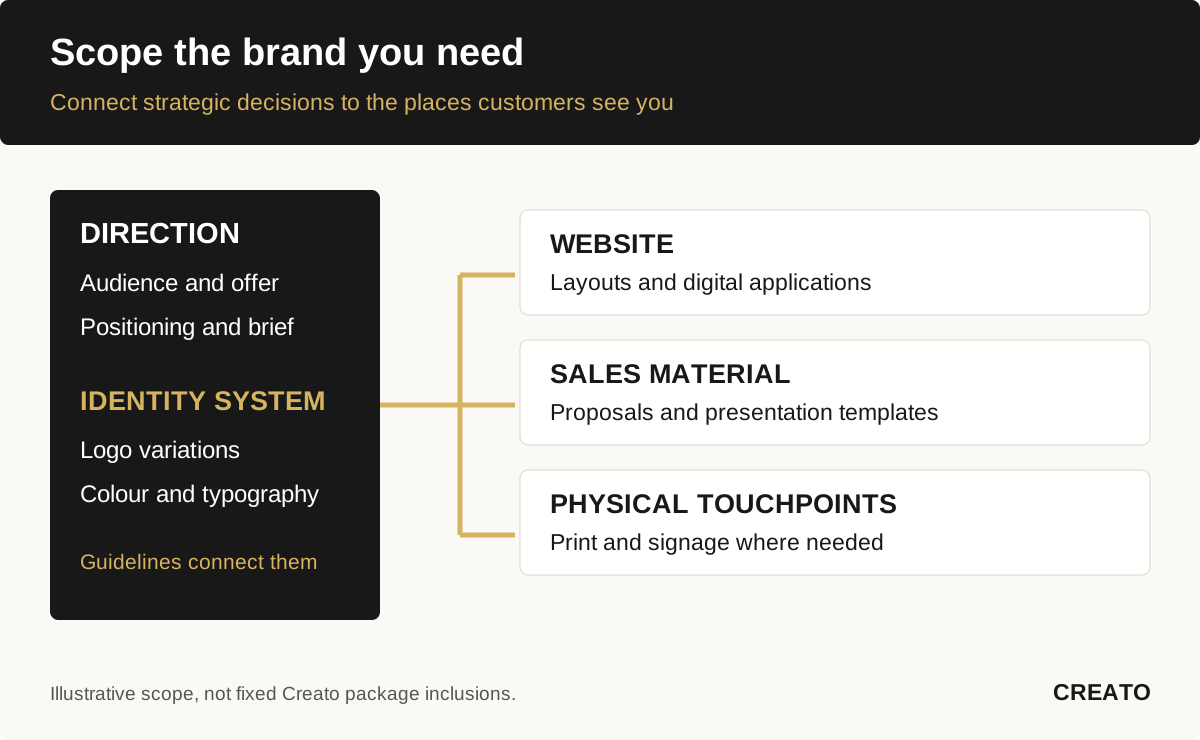
Choose deliverables for your next business step. Illustrative scope layers, not fixed Creato package inclusions.
What a branding package can include
Branding brings together decisions about how your business is understood and how it presents itself. Some projects focus on visual design. Others also cover positioning, messaging or naming. These should not be assumed simply because a proposal uses the word “brand”.
Possible component | What to clarify | How you might use it |
|---|---|---|
Strategy and positioning | Research inputs, workshops and written recommendations | Agree the audience and value your identity needs to communicate |
Logo system | Primary mark, alternate arrangements and small-format versions | Website, social profiles, signage and documents |
Colour and typography | Colour values, type choices and font licensing responsibilities | Keep materials visually consistent |
Brand guidelines | Rules, examples and practical instructions | Help staff and suppliers apply the identity |
Templates | Exact template types, quantity and editing software | Create repeat materials without starting again |
Rollout assets | Named print and digital deliverables | Launch the identity across agreed touchpoints |
Use this as a scope checklist, not a list every business must buy. A small professional practice may need a strong identity, proposal template and website direction. A product business may also need packaging and a way to distinguish product ranges. Those are different briefs.
Choose a scope around your next business step
You are launching a new business
Start with the audience, offer and places the identity will appear first. If your name or service model is still changing, settle those decisions before final artwork. Otherwise, approved design work may need to be revisited for reasons unrelated to its quality.
Identify the essentials for launch. For example, a business taking enquiries online may prioritise logo assets, website direction and a usable proposal document before a large set of social templates.
Your business has outgrown its existing identity
Explain what no longer fits. Perhaps the business now serves a different customer, offers a wider service or needs a more consistent presentation across a team. Share examples of the problem rather than asking only for something “more premium”.
Also identify what should remain recognisable. Existing colours, a symbol or a familiar name may carry value. A rebrand brief should make those considerations explicit without prescribing the design solution too early.
Your logo works but your materials are inconsistent
You may need a visual system and practical guidelines rather than a new logo. Gather recent presentations, PDFs, social posts and web pages. The differences between them can reveal where clearer rules or better templates would be useful.
A launch scope you can adapt
Consider a hypothetical consulting business preparing to take enquiries through a new website. The founder has settled the name and offer but has no consistent visual identity. This is an illustrative planning exercise, not a Creato client project or fixed package.
Priority | Possible decision | Reason |
|---|---|---|
Include in the requested scope | Logo system, colours, typography, concise guidelines and a proposal template | Supports the first website, sales conversations and client documents |
Optional after review | Social templates and additional stationery | Useful if those channels are active and someone will maintain them |
Defer | A large merchandise range | No immediate customer-facing use has been identified |
Confirm separately | Website build, printing, photography and specialist trade mark advice | Do not assume these are covered by the identity fee |
Your priorities may differ. The value of the exercise is a clear decision for each deliverable, with a reason and an owner, before the quote is approved.
Assess the thinking as well as the artwork
A portfolio helps you judge visual quality, but ask how the designer approaches your particular situation. What information do they need about your customers? How will they evaluate whether a proposed direction suits the brief? Who will present the work and respond to feedback?
Look at applications, not just a logo on a large empty background. Your identity should work in the places you actually use it. A detailed mark may need a simpler version for a small profile image. A restrained identity may need carefully designed layouts and imagery to communicate its character.
A useful review tests the work against agreed criteria: legibility, relevance to the audience, consistency and suitability for the intended applications. Personal preferences still matter, but they are easier to discuss within a clear brief.
Ask these questions before approving a package
Which strategy and messaging decisions are included, and which remain our responsibility?
What counts as a concept, a refinement and a change of direction?
Which final files and logo variations will we receive?
Who arranges any font, photography or other third-party licences?
Are templates supplied in software our team can use?
Does the price cover design only, or also printing and production?
What approvals are needed before final files are released?
Which rights transfer, and what limitations apply to third-party assets?
Get these answers in writing. A package advertised with extensive revisions still needs a shared understanding of the original brief, the feedback process and additional deliverables. Design rights and a trade mark registration are also separate matters; do not assume buying artwork completes every business-name or brand-protection step.
Make the handover useful
Ask for files organised by purpose. Your printer, website designer and internal team may need different formats. A folder full of unexplained exports creates avoidable uncertainty when someone needs the correct version quickly.
Guidelines should show how to use the identity in practice. Alongside colour and type information, useful instructions can cover clear space, backgrounds, minimum sizes and examples of unsuitable use. The depth should match the people who will be applying the brand.
Creato's brand guidelines examples show how identity rules can be documented. Use examples to think about the handover your own staff and suppliers will need, rather than copying another company's visual system.

A practical sequence for adopting an approved identity. Schedule production around approvals and existing printed stock.
Plan the rollout before changing everything
Make an inventory of customer-facing materials and assign an owner to each. Prioritise the website, proposals, contact details and active marketing. Then schedule less frequently used items, considering stock already printed and suppliers' production requirements.
Keep one approved master folder and retire outdated templates. Brief the people who will use the assets, including external suppliers. A consistent rollout depends on accessible files and clear responsibilities as much as it depends on design quality.
Discuss your branding scope with Creato
Explore Creato's logo design service for current package information. If you need a broader identity or rollout, tell us what your business is preparing for. Share your audience, existing materials and the assets you need at launch so we can discuss a focused scope rather than a package built around unnecessary extras.