Published
Author

Callum
Categories
AEO & GEO


Ready to take it a step further?
Let's start talking about your project or idea and find out how Creato can help your business grow.
A useful local SEO package should explain which customers and locations it targets, what work will be completed and how progress will be assessed. A monthly fee and a list of keywords do not tell you enough to judge whether the service suits your business.
For an Australian business, the right scope depends on where you genuinely operate, the services you want to grow and the condition of your website and business information. A single-location practice and a business serving several regions may need different priorities.
Use this guide to compare proposals, ask better questions and understand what you will retain if the engagement ends.
Start with your actual service area
List your physical locations, the areas you serve and any practical limits on the work you accept. Then identify the services that matter commercially. “More visibility in Sydney” is less useful as a brief than a clear explanation of the customers and jobs you want.
Location affects what people see. Google explains that local results depend mainly on relevance, distance and prominence or popularity. It also says businesses cannot request or pay for a better local ranking. An agency can improve information and website foundations, but it cannot remove distance from the equation. See Google's local ranking guidance.
Ask how the proposal reflects your operating model. A business visiting customers should not be presented as having a staffed office in every suburb. Your public information needs to match what customers can actually expect.

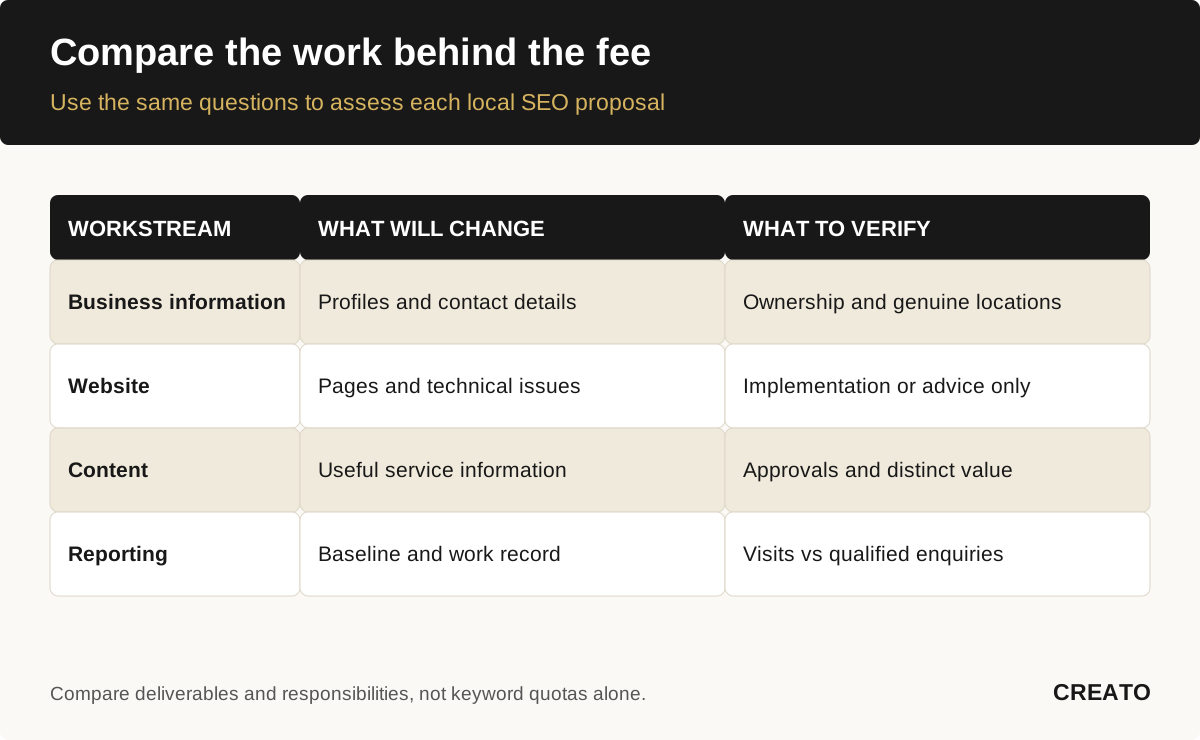
A useful local SEO proposal answers four questions. A keyword quota alone does not define a useful scope.
What to look for in a local SEO package
Workstream | Useful deliverable | Question to ask |
|---|---|---|
Starting-point review | A prioritised list of issues and opportunities | Which problems will you address first, and why? |
Business information | Review of relevant profiles and inaccurate details | Which profiles are included and who owns them? |
Website improvements | Specific service-page and technical changes | Does the fee include implementation or recommendations only? |
Location content | Useful information about genuine locations and service areas | What distinct information will each page provide? |
Customer feedback | A practical process for requesting honest reviews | How will the process avoid incentives and selective requests? |
Measurement | A baseline, work log and meaningful performance report | How will enquiries be separated from visits and rankings? |
The detail matters more than the number of tasks. A long directory-submission list may be less useful than correcting the information customers actually rely on. Equally, a report that identifies a broken enquiry form is of limited value if nobody is responsible for fixing it.
Separate initial work from recurring work
The first stage may involve access checks, measurement setup, inaccurate business details and priority page improvements. Ongoing work should build from those findings rather than repeat the same checklist indefinitely.
Ask what is expected in the first delivery period and how later priorities are chosen. A sensible scope leaves room to respond to evidence while making responsibility clear. If a technical issue needs a developer outside the engagement, identify that dependency and its potential cost before it stalls the work.
For each proposed task, establish who supplies information, who approves it and who implements it. Your agency may draft a service description, but someone in your business should verify the service, operating area and any specialist claims.
Be careful with location page promises
A package offering a large number of suburb pages can sound comprehensive. Before approving it, ask what a customer will learn on each page that they cannot learn elsewhere on the site.
A genuine location may have distinct opening hours, directions, staff and service details. A service-area page might explain relevant local project experience or practical coverage. Simply changing place names in otherwise identical copy does not create a useful buying guide.
Sometimes a strong main service page and a clear coverage section are the better starting point. The structure should be easy for customers to navigate and realistic for your team to maintain.

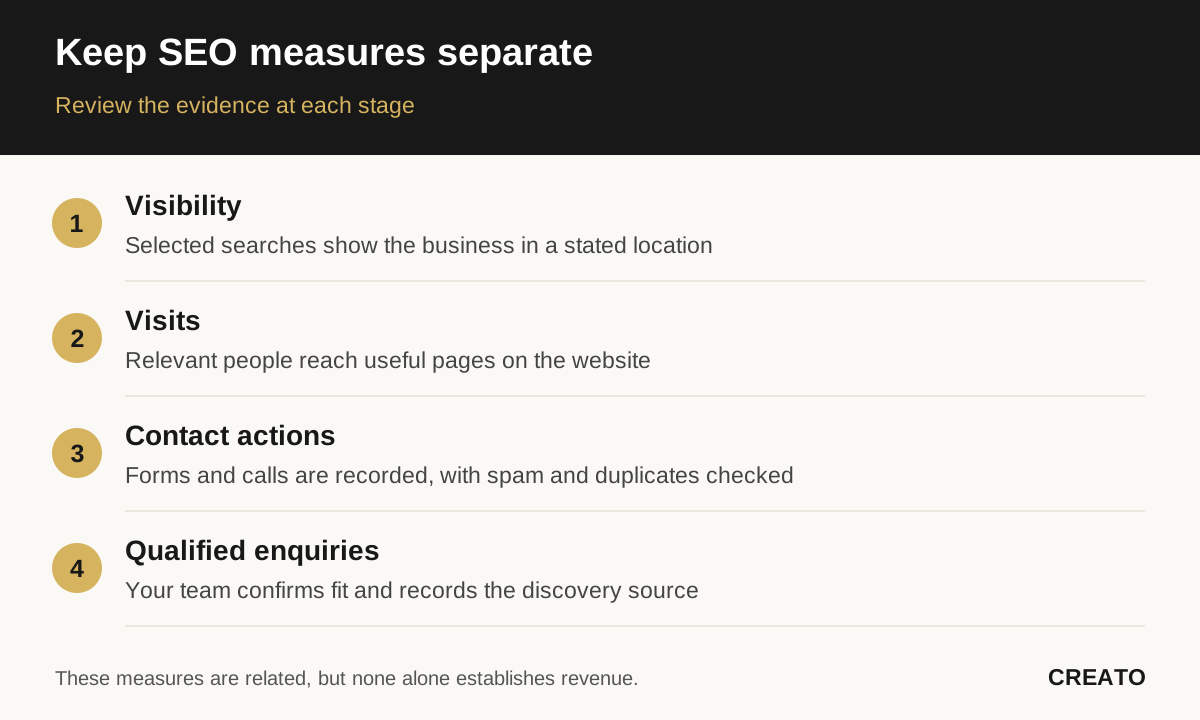
Review the evidence at each stage. These measures are related, but none alone establishes revenue.
Read the reporting promise carefully
Rankings, visits and enquiries answer different questions. A visibility improvement suggests more discovery opportunities. A relevant website visit suggests interest. An enquiry gives your business an opportunity to assess fit. None should automatically be reported as revenue.
Measure | What it can tell you | What to clarify |
|---|---|---|
Local visibility | Whether selected searches show the business | Search locations, terms and reporting method |
Organic website visits | How search visitors reach and use the site | Relevant landing pages and tracking limitations |
Calls and forms | Recorded contact actions | Spam, duplicates and whether calls were answered |
Qualified enquiries | How well the work attracts suitable prospects | Your team's definition and recording process |
Agree the starting baseline and a review cadence. Read the report alongside a record of completed changes. If enquiries are unsuitable, revisit the offer and page content rather than assuming a larger volume of visits will solve the problem.
Check ownership and commercial terms
Your business should understand and retain appropriate control of its website, domain, business profiles and measurement accounts. Ask how access will be granted and removed, and what happens to content, reports and configurations when the arrangement ends.
Compare fees on the same basis. Confirm whether GST, third-party subscriptions, copywriting, development and paid advertising are included. Advertising spend and organic SEO work should be identified separately. Also check notice periods, minimum terms and how additional work is approved.
For a first-year cost comparison, add the setup fee, twelve monthly fees and any required separately quoted implementation or software. Use the same GST basis for each proposal, and adjust the number of months if the comparison covers a shorter period. Keep optional work separate and list unknown costs beside the total. Do not divide a setup fee away and overlook it when comparing the first year's cash commitment.
A clear proposal should make it possible to explain the engagement to another decision-maker without relying on a sales presentation.
Common questions about local SEO packages
Is the cheapest package enough?
It depends on what needs fixing and what the package includes. A narrow scope can be useful if it addresses your priority. It is less useful when critical implementation is excluded and there is no one available to complete it.
Can a package guarantee the top map position?
No provider controls every ranking factor or every customer's location. Ask for accountable deliverables and transparent reporting instead of a guaranteed position or lead count.
Do I need a new website first?
Not necessarily. Existing pages and enquiry paths may be improved within the current platform. A rebuild should follow a clear explanation of limitations and benefits, not be treated as an automatic prerequisite.
Discuss a local SEO scope with Creato
Creato's SEO service covers local business information, useful location content and website foundations alongside the customer journey. If your site needs broader work, our website design service can help shape a clearer presentation.
Send us your website and service areas, along with the enquiries you want to attract. We can discuss the priorities and a scope that makes the proposed work, responsibilities and separate costs clear.