Published
Author

Callum
Categories
AEO & GEO


Ready to take it a step further?
Let's start talking about your project or idea and find out how Creato can help your business grow.
An accounting firm can be busy with enquiries and still be building the wrong client base. A request for a low-cost individual return is not the same opportunity as a business needing monthly reporting, tax compliance and ongoing advice. Both may be legitimate enquiries, but they require different economics, capacity and service models.
The mismatch often begins on the website. A firm describes itself as helping everyone with everything, publishes broad tax articles and then wonders why prospective clients arrive with expectations the team cannot meet. AI search does not fix that ambiguity. It can expose it to more people.
A better strategy makes the firm’s actual fit clear: the businesses or individuals it serves, the jurisdictions it covers, the services it provides and the evidence behind its expertise. This guide is about marketing an accounting practice, not tax, investment or financial advice. Any tax-related content your firm publishes needs appropriate professional review.
Define the clients you want before the prompts you want to appear in
Start with the work your team can deliver well and profitably. A cloud-accounting practice serving owner-managed businesses has a different proposition from a specialist international-tax adviser or a firm focused on personal returns. Do not combine their search demand into one undifferentiated lead target.
Interview partners and client managers about good-fit engagements. Record business type, service needs, complexity, software environment, communication expectations and geographic or jurisdictional limits. Include the clients you are not equipped to support. This is not about excluding difficult questions; it is about making your capabilities understandable.
Translate those differences into realistic research journeys. A growing agency may ask when it needs management accounts, then compare outsourced finance support, then look for an accountant familiar with project-based revenue. A sole trader may need help understanding what information to prepare before an initial meeting. They should not land on the same vague sales page.
Your strongest opening topic is often a recurring operational misunderstanding: a bookkeeping package that does not include tax work, a compliance engagement mistaken for ongoing advisory, or an owner expecting real-time reporting from records supplied late. Explain service boundaries rather than hiding them until proposal stage.
Understand the role of AI search without overstating it
AI-assisted discovery can help a person formulate a question, compare service types or find firms to investigate. A mention, a citation and an actual enquiry are different events. A firm can appear in an explanatory answer without being recommended, and an interested reader may later return through a branded search.
Google’s AI-feature guidance points back to SEO foundations and does not guarantee inclusion. Treat AI visibility as an additional discovery opportunity, not a replacement for accurate pages, credible people and a functioning enquiry process.
For accounting firms, specificity helps readers evaluate relevance. State the country and service context instead of assuming that “tax accountant” means the same thing everywhere. Distinguish bookkeeping, tax preparation, audit, advisory and regulated financial services according to what your firm is authorised and qualified to offer.
Our SEO, AEO and GEO comparison provides a broader framework. The useful question for a practice is not which acronym sounds newest, but which improvements make the firm more discoverable and understandable to appropriate prospective clients.
Build service architecture around decisions, not internal departments
Clients rarely begin with your organisational chart. They begin with a problem: unreliable monthly numbers, changing business complexity, a need to change accountants or uncertainty about what an engagement includes. Your navigation should connect that problem to a clearly described service.
Create substantial pages for important service lines and genuine specialisms. Explain who the service suits, what information is needed, what the engagement typically covers and what remains outside scope. Avoid publishing a menu of impressive terms that leaves an owner unable to choose a next step.
Industry pages can be useful when there is real expertise behind them. An accountant serving construction businesses might discuss reporting workflows and project information at a general level, with reviewed examples. A page should demonstrate genuine understanding rather than merely replace “construction” with “hospitality” in an otherwise identical template.
Link supporting articles to the service they illuminate. An article about changing accountants should connect to onboarding information; one about management reporting should connect to the relevant service, not only the contact page. The reader should see how the educational content relates to a real engagement.
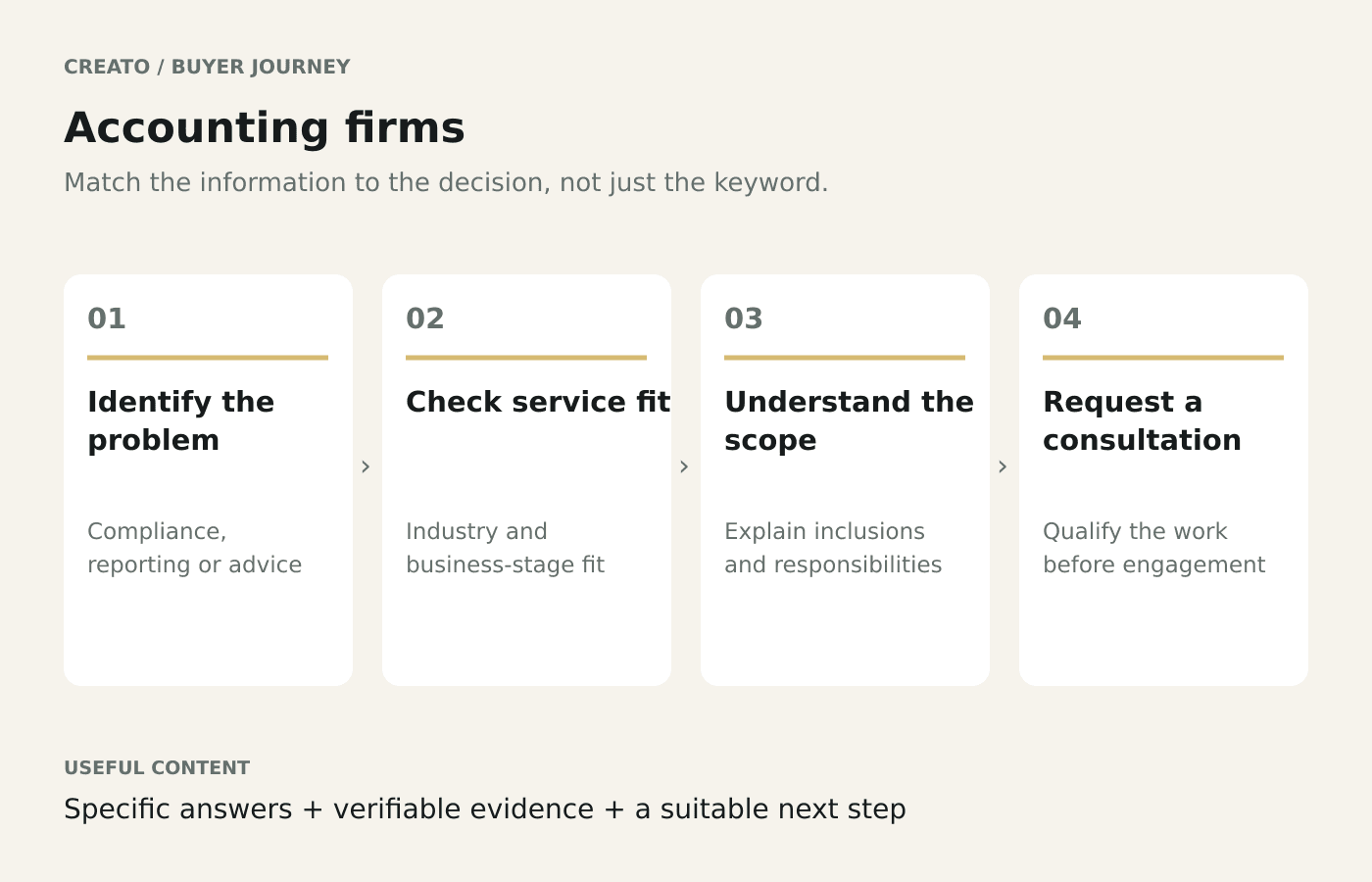
A practical content-planning framework. Real buying journeys may loop or involve several decision-makers.
Publish tax-related information with an expiry mindset
Tax content is particularly vulnerable to becoming wrong quietly. A page may remain visible after a threshold, programme, form or interpretation changes. A date in the title does not solve that problem if the firm lacks a review process.
Give each article a clear country or jurisdiction, a genuine review date, an accountable professional reviewer and a defined update trigger. Link important technical statements to authoritative sources where readers need to verify them. If a rule changes, assess related service pages and downloadable resources too, not only the original article.
Avoid answering an individual tax situation from a generic scenario. Explain what factors need assessment and how a qualified adviser would establish the facts. Never promise a refund, saving or preferred structure simply because those phrases might attract search demand.
Distinguish evergreen process guidance from time-sensitive technical content. How to prepare records for an accountant can remain useful with periodic review; a page about a specific filing rule may need more active maintenance. A smaller library with reliable ownership is more credible than a large archive nobody is willing to check.
Make credentials and professional scope verifiable
A biography should tell a prospective client who will do the work, what qualifications they genuinely hold and what experience is relevant. Professional memberships, registrations and software certifications are not interchangeable. Explain them accurately instead of arranging badges to imply a broader authorisation.
In Australia, the Tax Practitioners Board public register allows people to check tax and BAS agent registration and includes specified public-record information. Link or describe the relevant verification route where appropriate. Do not imply that every accountant has the same registration or permitted service scope.
In the United States, the IRS guide to choosing a tax professional distinguishes preparer types and qualifications. That is a useful reminder to localise terminology. An Australian service description should not be repurposed for US prospects by changing the currency and leaving the professional context untouched.
Show evidence without exposing clients. Explain a documented process, a permitted anonymised example or a public professional contribution. Do not claim savings, growth or successful outcomes that cannot be substantiated. A testimonial from one client is not proof that another business will achieve the same result.
Use original operational knowledge as your content advantage
The best accounting content often comes from questions the team answers every week. What makes a month-end reporting process slow? What does an adviser need before an initial discussion? How should a business compare service proposals when inclusions differ? These topics show understanding without giving personalised advice.
Ask client managers for patterns, not client files. Turn recurring misunderstandings into an outline, have a qualified person review the substance and let a writer make it accessible. Keep real names, financial details and identifiable circumstances out unless a separate publication process has properly authorised them.
Useful formats include a plain-language service comparison, an onboarding checklist, a diagram of information flow or an explanation of who is responsible for which task. Make tools genuinely usable. A checklist that exists only behind an aggressive lead form may frustrate a reader who simply needs to understand the process.
Do not manufacture proprietary research. If your firm has measured a result, document the sample, timeframe and limits before publishing it. If you are illustrating a workflow, label it as an example. Readers can tell the difference between practical expertise and a statistic created to decorate a headline.
Design an enquiry route that qualifies without demanding financial records
An initial form can ask about service interest, broad business context and preferred contact details. It does not need bank statements, identity documents, tax identifiers or complete financial records. Detailed onboarding belongs in the firm’s approved secure process after the appropriate checks and engagement steps.
Explain what happens next. Is the person requesting a discovery call, asking for a proposal or booking a paid consultation? If availability is limited during peak periods, state the real position rather than advertising an instant start that the team cannot deliver.
Make service scope visible before the form. If the practice does not handle individual returns, say so politely and prominently. If it offers ongoing packages rather than isolated advice, explain that without inventing a minimum commitment. Clear fit information saves time for both the firm and the prospective client.
Test delivery and routing. A successful confirmation screen does not prove the responsible team received the enquiry. Check notifications, spam handling and fallback contact details. Keep sensitive form content out of analytics events, advertising parameters and unnecessary third-party systems.
Compare SEO and advertising against capacity and seasonality
Paid search can be useful for defined services with clear intent and available delivery capacity. Organic search can support a longer research journey and answer questions that lead to better-informed enquiries. Neither channel is automatically best for every accounting practice.
Seasonality matters, but it is not universal. Tax calendars, client types and service lines vary across countries. An advisory practice may have a different demand pattern from a personal-return business. Plan around your actual capacity and calendar rather than copying another market’s seasonal campaign.
For ads, review what people searched for and what the campaign counts as a conversion. Cheap forms for a service you do not offer are not efficient acquisition. Separate legitimate enquiries from sales pitches, job applications and existing-client requests before evaluating cost per opportunity.
For SEO, improve the important service pages and publish a focused group of reviewed resources. Expect to maintain them. Do not compare one month of ad spending with a content programme’s total cost and then declare a winner without considering timing, attribution, delivery and client quality.
Model first-year contribution before claiming lifetime value
Consider this hypothetical example only. It is not an accounting-sector benchmark, Creato case study or forecast. Assume A$3,000 in marketing cost, 20 qualified enquiries and A$2,000 first-year contribution per new client after direct delivery and onboarding costs, before marketing and general overheads.
At a 10% engagement rate, two new clients produce A$4,000 first-year contribution, leaving A$1,000 after marketing. At 20%, four clients produce A$8,000, leaving A$5,000. At 30%, six clients produce A$12,000, leaving A$9,000. This is a cohort model: the first-year contribution is not all received in the acquisition month.
The expected first-year contribution per qualified enquiry is A$200, A$400 or A$600 under those assumptions. Those figures are not automatic allowable acquisition costs. The firm still needs to cover overheads, manage cash flow and allow for uncertainty, non-payment and changes in workload.
Do not multiply a recurring fee by an optimistic number of years and call the result profit. Use observed retention and delivery data if you model later periods. Separate service lines with different onboarding burdens. A profitable recurring engagement and a time-consuming one-off clean-up should not be blended until their economics are understood.
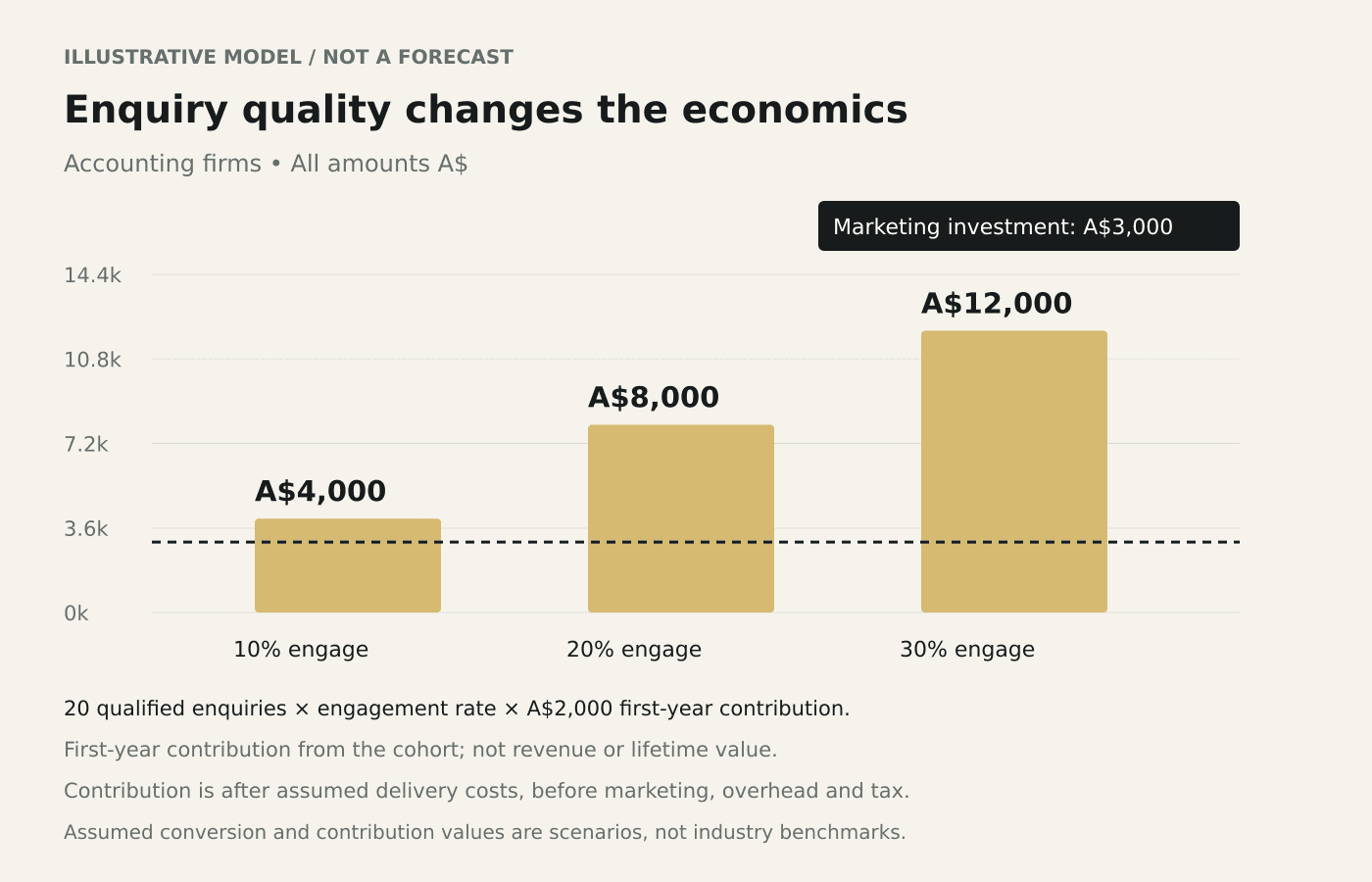
20 qualified enquiries × engagement rate × A$2,000 first-year contribution. First-year contribution from the cohort; not revenue or lifetime value. These are assumptions, not results or benchmarks.
Report on suitable engagements, not vanity metrics
Track the stages your team can verify: relevant visits, genuine enquiries, qualified opportunities, proposals, engaged clients and observed contribution. Agree definitions with the people doing intake. A lead marked qualified should satisfy a consistent standard, not simply have a functioning email address.
Measure why opportunities fail to progress. Was the service wrong, the timing unsuitable, the proposal unclear or the team unavailable? Those reasons guide different improvements. Without them, marketing teams often respond to every problem by buying more traffic.
For AI monitoring, use a stable set of realistic service and jurisdiction questions. Record dates, platforms, answers and citations. Compare patterns over time without pretending that a small prompt sample measures the whole market. Check that a cited page still says what the generated answer implies.
Our monthly SEO reporting guide explains how to make reporting decision-useful. Add professional-service measures rather than allowing a ranking dashboard to stand in for a client pipeline.
A workable plan for the next quarter
First, clarify the desired client mix and audit the existing site against it. List misleading scope descriptions, outdated technical pages and broken enquiry routes. Assign a responsible person to each correction. Agree what the marketing team can publish independently and what requires professional review.
Next, strengthen the main service pages and a small set of supporting resources. Use actual team knowledge to make them specific. Add appropriate images and diagrams, verify credentials and review the mobile enquiry experience. Establish the update process before expanding the library.
Then evaluate real outcomes. If the firm attracts the wrong work, refine the proposition. If suitable opportunities arrive but proposals stall, inspect the commercial handoff. If visibility is weak, diagnose technical access and relevance before commissioning dozens more articles.
This is an implementation sequence, not a promise that a quarter produces a particular number of clients. The right pace depends on the existing site, review capacity, competitive environment and the firm’s ability to onboard new work without reducing service quality.
Make your expertise easier for the right clients to recognise
Accounting firms do not need to sound like every other adviser to appear in AI search. Clear service boundaries, genuine professional expertise and useful explanations are stronger foundations than a large volume of interchangeable tax content.
Creato can help plan the website and content work through SEO services and AEO and GEO services, with measurement tied to the enquiries that matter.
Talk to Creato about your accounting firm’s search and enquiry journey if you want to identify the highest-priority improvements. Bring your target client profile and current service mix, not just a list of keywords.
You can also explore the Creato blog and technical AEO and GEO guide for the implementation foundations behind a reliable search strategy.


