Published
Author

Callum
Categories
AEO & GEO


Ready to take it a step further?
Let's start talking about your project or idea and find out how Creato can help your business grow.
A full appointment book can hide the wrong marketing problem. Your practice may have plenty of short-notice calls but too few suitable new patients, spare capacity on particular days, or a reception team spending hours explaining services you do not provide. More leads are not automatically better utilisation.
Dental marketing has another boundary that many generic growth guides ignore: the patient is not a sales target to push towards treatment. Clinical suitability, informed choice and appropriate professional standards come first. A successful discovery journey helps someone find a suitable practice and understand the next step without promising a clinical outcome.
That is the starting point for ranking a dental practice in AI search. This guide covers search visibility, useful content, appointment journeys and honest economics for dental owners and managers. It is marketing guidance, not clinical advice. Regulatory examples are identified by country and require local review before implementation.
Separate discovery from a clinical recommendation
People may ask AI assistants to find a dentist with evening appointments, explain what a first visit involves or compare practices offering a particular service. Those questions contain different needs. A search result or generated answer is not a diagnosis, a suitability assessment or an endorsement by a regulator.
Google’s AI-feature documentation says ordinary SEO foundations still apply and that qualifying pages are not guaranteed inclusion. There is no separate trick that makes a practice a guaranteed recommendation. Start with a technically accessible site and accurate, useful information.
Your objective is to help a suitable patient discover the practice, verify practical details and arrange an appropriate consultation. Measure each stage separately. Being cited for an explanation does not establish that the reader booked, attended or required treatment.
The broader distinctions are covered in our SEO, AEO and GEO strategy guide. For dentistry, apply them with a stronger emphasis on patient understanding and professionally reviewed claims than a generic ecommerce playbook would require.
Map the patient journeys your reception team actually handles
Ask reception to categorise recent enquiries without copying identifiable patient details into marketing documents. Useful categories might include new-patient examinations, urgent appointment availability, family appointments, accessibility questions, existing-patient administration and requests for services the practice does not offer.
Then identify where the website creates avoidable confusion. Perhaps people assume you are open on Sundays because an old directory says so. Perhaps a cosmetic service page omits that assessment is required. Perhaps the booking widget makes existing and new patients choose the same appointment type even though the practice handles them differently.
Create content around those practical gaps. A first-visit page can explain appointment logistics, what information the practice asks people to bring and how fees are discussed. An accessibility page can describe verified facilities and how to ask for assistance. A service page can explain the consultation process and identify the clinician responsible for reviewing its information.
Do not build content solely around the most expensive procedures. A patient’s question should lead to appropriate care, not to a predetermined high-value treatment. Make it straightforward to ask about a concern without implying that the reader already needs the service featured on the page.
Give each practice location a truthful, useful page
A multi-location group should explain what is actually available at each site: opening hours, address, contact route, accessibility, appointment options and clinicians where accurate. Do not imply that every location offers every service simply because the group offers it somewhere.
Keep business profiles consistent with the website. Google’s local-ranking guidance identifies relevance, distance and prominence as important factors and recommends accurate business information. A national marketing strategy does not remove the local nature of most in-person dental appointments.
For single-location practices, depth is usually more useful than hundreds of interchangeable suburb pages. Explain real travel, parking and access details when they help patients. Avoid claiming a physical presence where none exists. For groups operating across countries, keep local contact information and regulatory context distinct.
Photographs should help people recognise the entrance, reception area and genuine team. Use current, permissioned images without exposing patients or records. A polished stock photograph can illustrate an idea, but it should not pretend to depict your clinicians, equipment or premises.
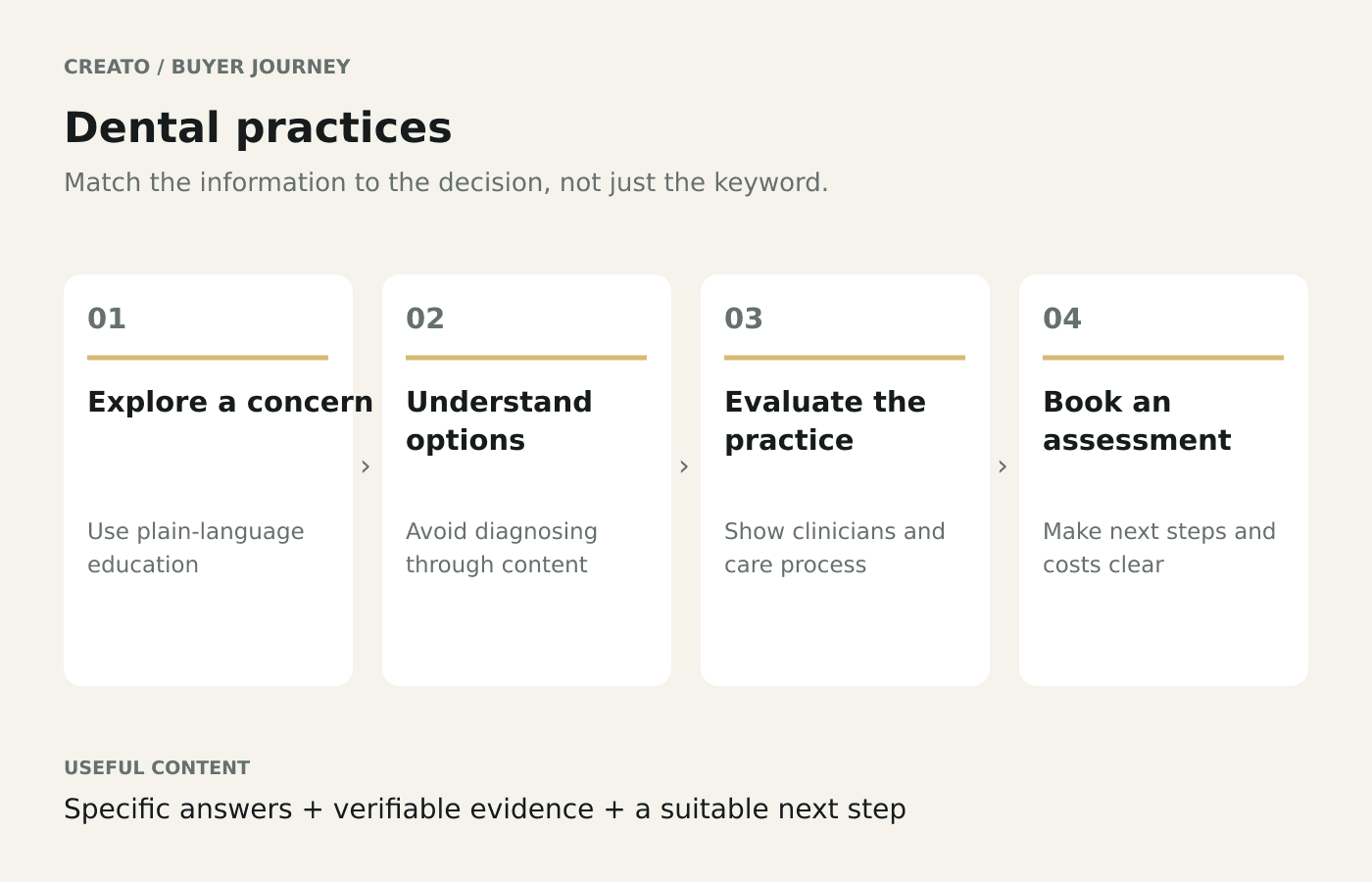
A practical content-planning framework. Real buying journeys may loop or involve several decision-makers.
Write service information that helps patients make sense of the next step
A service page should explain what the practice offers and how someone can find out whether it is appropriate. It should not attempt to diagnose the visitor. Use plain language, explain unfamiliar terminology and avoid implying that one treatment is right for everyone.
Structure the page around questions patients actually raise: what an assessment involves, which practitioner they may see, what can affect cost, how appointment stages are discussed and where individual questions should go. Have the clinical team determine what information is appropriate and what needs qualification.
Do not hide uncertainty in tiny text below a confident headline. If suitability depends on assessment, make that visible beside the main explanation. If a quoted price excludes components, make the scope clear. The marketing team should not invent inclusions, finance arrangements, recovery expectations or guarantees to make a page feel more complete.
Use real expertise to produce original material. A dentist can review a draft for misleading simplifications; reception can check whether booking instructions match reality; the practice manager can verify pricing and availability information. This combined review often produces a better patient resource than adding another thousand generic words.
Handle dental reviews and evidence carefully
Australian practices need particular care with testimonials. Ahpra’s advertising guidelines distinguish the use of testimonials about clinical aspects of regulated health services from other kinds of feedback. They also address misleading advertising and unreasonable expectations. A review widget is therefore not an automatic, harmless conversion improvement.
Do not lift a patient’s treatment story from a review platform and place it on a service page without considering the applicable rules. Consent alone does not settle every advertising issue. Have the practice’s compliance adviser review proposed testimonials, before-and-after material, offers and outcome claims in the relevant jurisdiction.
Other countries have different requirements. Do not apply an Australian summary as though it were a global rule, or assume a US competitor’s advertising is suitable for your market. This article is not a compliance checklist. It identifies decisions that deserve professional review before publication.
Evidence does not have to mean dramatic outcomes. Accurate practitioner qualifications, clearly described facilities, transparent appointment processes and useful patient information all help someone evaluate a practice. Never fabricate a patient story, rating, award or treatment result to make the page more persuasive.
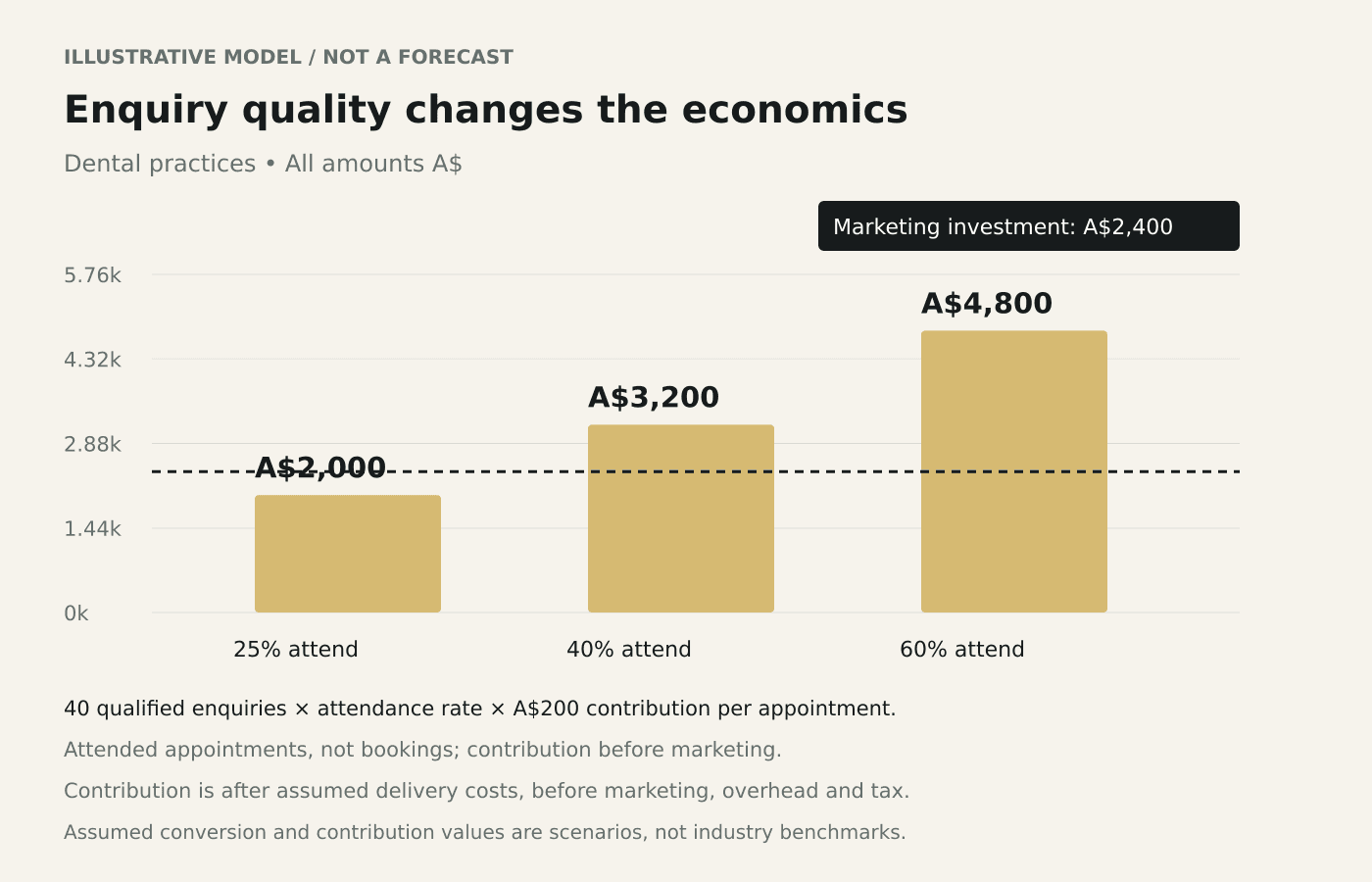
40 qualified enquiries × attendance rate × A$200 contribution per appointment. Attended appointments, not bookings; contribution before marketing. These are assumptions, not results or benchmarks.
Make appointments easy without collecting too much too soon
A visitor should be able to understand whether they are making a confirmed booking, requesting an appointment or asking the practice to call. Those are different promises. A form that merely emails reception should not display a confirmation implying that clinical time has been reserved.
Keep the initial marketing enquiry minimal. Do not require detailed medical history, photographs or identity documents merely to request contact. Move clinical intake into the practice’s approved secure workflow. Explain the purpose of the form and provide an alternative route for people who cannot use it.
Test the entire journey with clearly labelled internal test data and remove or segregate it from reporting. Check mobile layout, form delivery, booking-system handoff and the staff notification. If appointments happen in a separate system, confirm what tracking is permitted rather than assuming the website sees the final outcome.
Do not send clinical details into general analytics tools. Event names, URL parameters and form payloads deserve review. A useful marketing report can distinguish enquiry, booking and attendance without exposing a patient’s symptoms or treatment history to unnecessary systems.
SEO versus paid ads: choose the job before the channel
Organic content can answer recurring practical questions and help people compare a practice over time. Paid search can reach people expressing a specific immediate intent, subject to advertising rules and actual campaign delivery. Neither guarantees suitable bookings, and neither should be used to manufacture clinical urgency.
Start with capacity. Which clinicians and appointment types can accept new patients? Which hours are genuinely available? What enquiries can reception handle promptly? A campaign that overwhelms an already stretched team may worsen the patient experience even if its cost per form looks attractive.
For paid campaigns, separate different intentions where useful and review irrelevant search terms. Measure calls and appointment requests accurately. A tap on the call button is weaker evidence than a connected conversation; a booking is different from an attended appointment. Avoid optimising blindly for the cheapest event.
For SEO, prioritise practical service and location pages before a large publishing schedule. Develop reviewed educational content that complements them. Useful pages may support discovery for a long time, but they also need maintenance. “Organic” does not mean free, and there is no universal timetable for meaningful visibility.
An illustrative appointment-value model
Here is a deliberately simple model for marketing decisions, not a recommendation about treatment or a dental-industry benchmark. Assume A$2,400 marketing cost, 40 qualified appointment enquiries and A$200 contribution per attended new-patient appointment after direct delivery costs, before marketing and general overheads. No future treatment is included.
If 25% of those enquiries become attended appointments, ten attendances produce A$2,000 contribution, A$400 below marketing cost. At 40%, sixteen attendances produce A$3,200 and leave A$800 after marketing. At 60%, twenty-four attendances produce A$4,800 and leave A$2,400.
The assumed break-even point is twelve attended appointments. That does not mean twelve bookings, twelve calls or twelve patients who might return later. The distinction is important when cancellations and non-attendance affect real capacity. These are arithmetic scenarios, not predicted results for your practice.
Replace every input with your own figures and account for capacity, overheads, taxes and cash timing. Do not justify acquisition spending by assuming every new patient purchases a high-value treatment. If you analyse retention, use observed cohorts and conservative contribution data, with appropriate privacy controls, rather than speculative lifetime revenue.
Measure the patient journey, not just website activity
Agree on a small reporting ladder: relevant visibility, service-page visits, legitimate enquiries, booked appointments and attended appointments. Add operational measures such as response time and appointment availability so the marketing team can understand what happens after the click.
Keep existing-patient administration separate from new-patient demand where feasible. A busy phone line may reflect rescheduling rather than successful acquisition. Equally, a campaign may help people who later search the practice name, so last-click attribution will not always capture the initial discovery.
Ask a simple optional question about how new patients heard of the practice, without pressuring them or requesting unnecessary details. Combine that with privacy-appropriate digital evidence. Treat self-reporting and analytics as complementary, imperfect views.
For AI visibility, test consistent practical prompts, record the answers and check whether cited pages genuinely support the claims. A single screenshot is not proof of stable ranking. Our monthly SEO reporting guide helps separate activity from meaningful outcomes.
Use images and diagrams to explain, not exaggerate
A helpful visual can show the booking sequence, identify the practice entrance or explain which team handles enquiries. These images reduce uncertainty without claiming that a particular clinical result is typical. Add useful alternative text and keep essential information available as text too.
Avoid generic smiling faces labelled as your patients or clinicians. Do not use AI-generated before-and-after examples as evidence of treatment results. If an image is illustrative, make its role clear. If a real patient is involved, follow the practice’s consent and advertising review processes before publication.
For charts, label assumptions prominently. A model comparing enquiry-to-attendance scenarios should not look like a graph of actual practice growth. Use distinct titles such as “Illustrative appointment economics” and include the underlying inputs. Honest visuals are more useful than dramatic but untraceable statistics.
A polished site should also work for people using assistive technologies or slower connections. Compress images, maintain readable contrast and make important buttons understandable without relying on colour alone. Good presentation supports access; it should not become another obstacle to arranging care.
A sensible rollout for a dental practice
Begin by checking the facts patients rely on: locations, hours, clinician information, services, fees where published and appointment routes. Correct inconsistencies before increasing promotion. Then review the highest-traffic pages with the clinical and reception teams to identify confusing or outdated content.
Next, choose a manageable set of priority journeys. Improve the relevant location and service pages, produce a few useful supporting answers and test booking delivery. Assign responsibility for periodic review, especially when team members, availability or services change.
Only then scale the channel mix. If qualified enquiries are not becoming appointments, investigate the handoff and capacity. If the wrong enquiries dominate, revise targeting and page clarity. If appropriate appointments are growing, expand carefully without losing clinical review or measurement quality.
Creato’s SEO services and AEO and GEO services can help align content, technical implementation and discovery.
Make the next step clearer for the right patients
Better AI visibility begins with a practice people can understand: accurate services, credible clinicians, useful information and a trustworthy appointment journey. It does not require treating every patient question as an opportunity to sell a procedure.
If you want help identifying the gaps between discovery and appointment, speak with Creato about your dental website and search strategy. We can discuss a scope around your actual services and capacity rather than a promise of guaranteed AI recommendations.
For related website and search guidance, explore the Creato blog and our technical guide to AI-search visibility. The goal is informed discovery and appropriate enquiries, with the clinical decisions left where they belong: between the patient and qualified professionals.


