Published
Author

Callum
Categories
AEO & GEO


Ready to take it a step further?
Let's start talking about your project or idea and find out how Creato can help your business grow.
A law firm can generate more enquiries and still win fewer worthwhile matters. A prospective client may be outside your jurisdiction, on the other side of an existing client, seeking work your team does not handle, or facing a deadline you cannot responsibly meet. A form submission is not an instruction. Anyone who has sat with an intake team knows the difference.
That distinction should shape your approach to AI search. The objective is not to make a chatbot mention your firm as often as possible. It is to help appropriate prospective clients discover credible information, understand whether your firm fits their problem, and take a sensible next step.
This guide explains how to build that system across organic search, AI-assisted discovery and paid search. It is written for law-firm owners and marketing teams, with clearly labelled regulatory examples. It is marketing guidance, not legal advice or an assurance of compliance in any jurisdiction.
What does ranking a law firm in AI actually mean?
A potential client might ask an assistant which employment lawyers handle senior executive exits, how to compare commercial litigation firms, or what to prepare before speaking to a family lawyer. The response may explain a process, cite a page, name several firms, or send the person back to conventional search. These are different discovery events, not one universal ranking.
Google’s guidance on AI features says existing SEO foundations apply, with indexed pages eligible for snippets needed for supporting links. Inclusion is not guaranteed. That is a better starting point than promises of secret AI submission or guaranteed placement.
For a firm, the practical work is to make expertise, jurisdiction, services and evidence easy to understand. Then evaluate whether relevant people reach intake. A citation of an educational article is encouraging, but it does not prove that an assistant recommends your firm or that the visitor is ready to instruct you.
Our guide to SEO, AEO and GEO explains the wider distinctions. For legal services, those channels should share an accurate evidence base rather than operate as competing marketing programmes.
Start with matter fit, not a giant keyword list
Before commissioning articles, ask each practice head which instructions the firm wants, can service and should decline. Capture jurisdiction, client type, matter type, urgency, commercial scope and capacity. A boutique advising employers should not accidentally build a content strategy that mostly attracts employees seeking representation.
Turn that discussion into search journeys. An owner facing a shareholder dispute may first ask what options exist, then compare experience with closely held businesses, then investigate cost and who will handle the matter. A person seeking conveyancing may have a clearer transaction and shorter buying process. Their questions, reassurance needs and intake routes differ.
Build a small topic map for each genuinely important practice. Separate explanatory questions from provider-comparison questions and immediate-contact questions. Record the page that should answer each. This stops five articles from competing to explain the same introductory topic while the actual service page remains vague.
Do not manufacture national coverage. A firm may serve clients across a country while still being restricted by admission, local rules or the type of work undertaken. Explain real reach and referral arrangements accurately. International enquiries deserve an even clearer distinction between a client’s location and the legal system governing the matter.
Make practice pages useful before expanding the blog
A useful practice page answers the questions a reasonable prospective client asks before sharing a problem. Who do you advise? What types of matters do you handle? In which jurisdictions? Who leads the work? What happens in the first conversation? What information is appropriate to send at that stage?
Consider a commercial-disputes page. Replace sweeping claims about aggressive representation with specific, supportable descriptions of work: contract disputes, shareholder disagreements or debt disputes, where those services genuinely exist. Explain the firm’s process at a high level without pretending every dispute follows the same path. Identify the responsible lawyers and link to substantial profiles.
Fees deserve careful language. If an initial discussion has a charge, say so. If a price covers only a defined stage, make that boundary prominent. Do not convert a complex engagement into a misleading fixed-price headline to improve conversion. Clear expectations can reduce unsuitable enquiries even when they reduce the raw number of forms.
Each supporting article should lead naturally to one relevant service page. A guide to preparing for an employment consultation belongs with employment services, not a generic list of every practice. The site should feel like a coherent firm, not a library assembled solely to attract traffic.
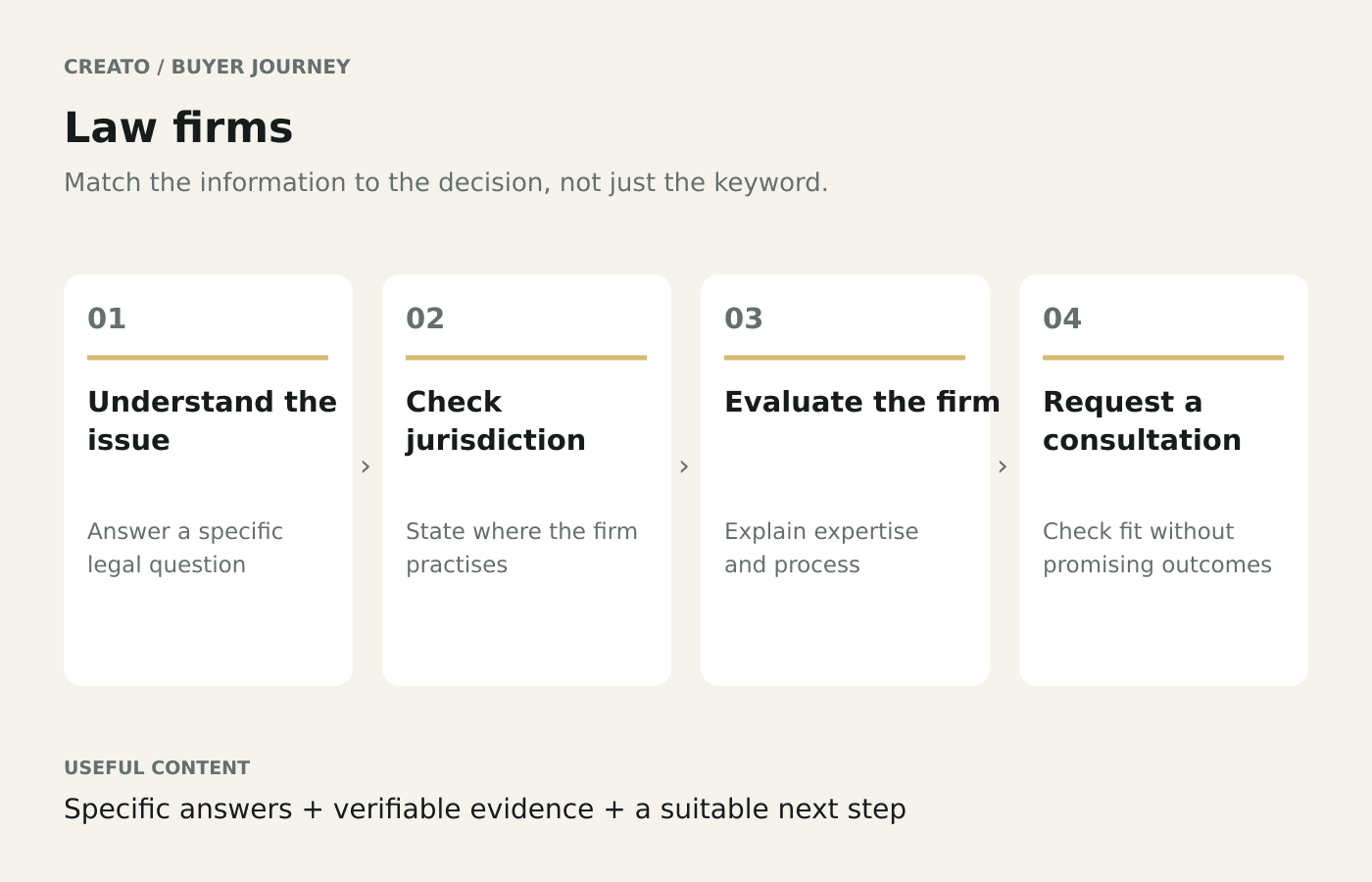
A practical content-planning framework. Real buying journeys may loop or involve several decision-makers.
Write answers that preserve legal context
Legal questions often look simple until the facts arrive. That makes context part of content quality. An answer should state its jurisdiction, identify the kind of situation being discussed, distinguish general information from an individual assessment, and explain which facts could change the position.
Open an article with a clear answer to the question, then add the necessary boundaries. Avoid hiding the useful explanation behind several paragraphs about how complicated the law is. Equally, do not publish absolute conclusions because short answers appear easier for machines to quote. Accuracy matters more than making a sentence extractable.
Use a qualified reviewer for legal substance. Show the reviewer’s real role and the date of substantive review. Establish an update owner for time-sensitive pages. A refreshed date without an actual review is not a maintenance system. Keep a record of what changed and why.
Original value can come from the firm’s process knowledge without exposing clients. Explain what documents make an initial meeting more productive, how different specialists work together, or what a prospective client should ask when choosing representation. Use fictional scenarios labelled as such if examples are needed. Never imply they are client outcomes.
Build trust without turning confidentiality into content
A polished lawyer profile is evidence only when its claims can be checked. Include accurate admission or registration information where appropriate, current responsibilities, relevant experience and genuine publications or speaking engagements. Avoid inflated specialisation labels, unsupported awards or badges that could imply a credential the lawyer does not hold.
Advertising rules vary. In the United States, ABA Model Rule 7.1 addresses false or misleading communications, but adopted state rules and their interpretation must be checked. In England and Wales, the SRA Code of Conduct includes publicity standards. Neither source is a universal global advertising code.
Client permission is not a substitute for considering every applicable duty. Before publishing case studies, testimonials or recognisable matter details, obtain the firm’s own compliance review. An anonymised story may still be identifiable through its facts. A dramatic outcome also does not establish what another client can expect.
External recognition should be earned and relevant: professional contributions, legitimate directories, specialist commentary and genuine community involvement. Buying a collection of invented recommendations is not authority. The marketing team should be able to explain where every important public claim came from.
Fix the technical route from answer to enquiry
Test your priority pages on a phone, not only a large office monitor. Can a visitor read the service description, identify the relevant lawyer and contact the firm without fighting overlays? Does a telephone link reach the correct team? Does the form produce a real notification with a sensible fallback if delivery fails?
Keep essential information in readable page content rather than only in decorative graphics or downloadable brochures. Give each substantial page one clear purpose and descriptive headings. Remove obsolete duplicates thoughtfully, preserving useful destinations rather than simply deleting pages that still attract visitors.
Treat structured data as a description of the visible business and content, not an extra advertising surface. Do not add untrue ratings, locations or credentials to code. Ask your developer to check crawl access, canonical URLs, redirects and sitemap inclusion after significant changes.
Our technical AEO and GEO guide covers the implementation layer. If the site’s foundations and practice architecture need work together, ask Creato to review the complete journey rather than buying more articles before the existing pages function.
SEO versus Google Ads for law firms
Paid search and organic content solve different timing problems. An ad can put a specific service in front of people expressing immediate intent, provided the campaign is eligible and actually serving. Organic pages can support research, comparison and repeat visits. Neither channel fixes an intake process that loses suitable enquiries.
For paid campaigns, distinguish practice groups, jurisdictions and client types. Review search terms and the meaning of conversions. A click on the telephone button is not automatically a completed call, and a completed call is not automatically a qualified matter. Use meaningful downstream outcomes where measurement, consent and platform rules allow.
For organic investment, expect work before reliable commercial conclusions: improving pages, publishing reviewed answers, earning relevant recognition and measuring results. There is no credible universal deadline for ranking or AI citation. Assess whether implementation and leading indicators are improving without treating every early fluctuation as success or failure.
A combined approach can make sense when the firm has capacity and sound measurement. Ads can test whether a specific proposition attracts appropriate enquiries while the site develops deeper coverage. Keep the experiment bounded by budget and matter type. Do not let a strong traffic graph justify spending on work the firm does not want.
Model value using engaged matters, not impressive traffic
The following example is entirely illustrative. It is not a Creato client result, a legal-sector benchmark, a fee recommendation or a forecast. Assume A$3,000 in monthly marketing cost, 20 qualified enquiries and A$2,500 contribution per engaged matter after direct delivery costs but before marketing and general overheads.
At a 5% engagement rate, those enquiries produce one matter and A$2,500 contribution, A$500 below marketing cost. At 10%, two matters produce A$5,000, leaving A$2,000 after marketing. At 20%, four matters produce A$10,000, leaving A$7,000. The same enquiry count produces very different economics.
Under these assumptions, the expected contribution per qualified enquiry is A$125, A$250 or A$500 respectively. Those figures are not sensible bidding targets by themselves: collection delays, capacity, overheads, risk and uncertainty still matter. Two whole matters would be needed to exceed the assumed marketing spend; fractional expected outcomes are not cash in the bank.
Use your own practice-level figures. Keep matters with materially different margins separate. Measure collected fees and delivery effort rather than substituting headline claim values, settlement amounts or maximum possible fees. Where a matter remains open, mark its contribution as provisional instead of quietly counting it as realised income.
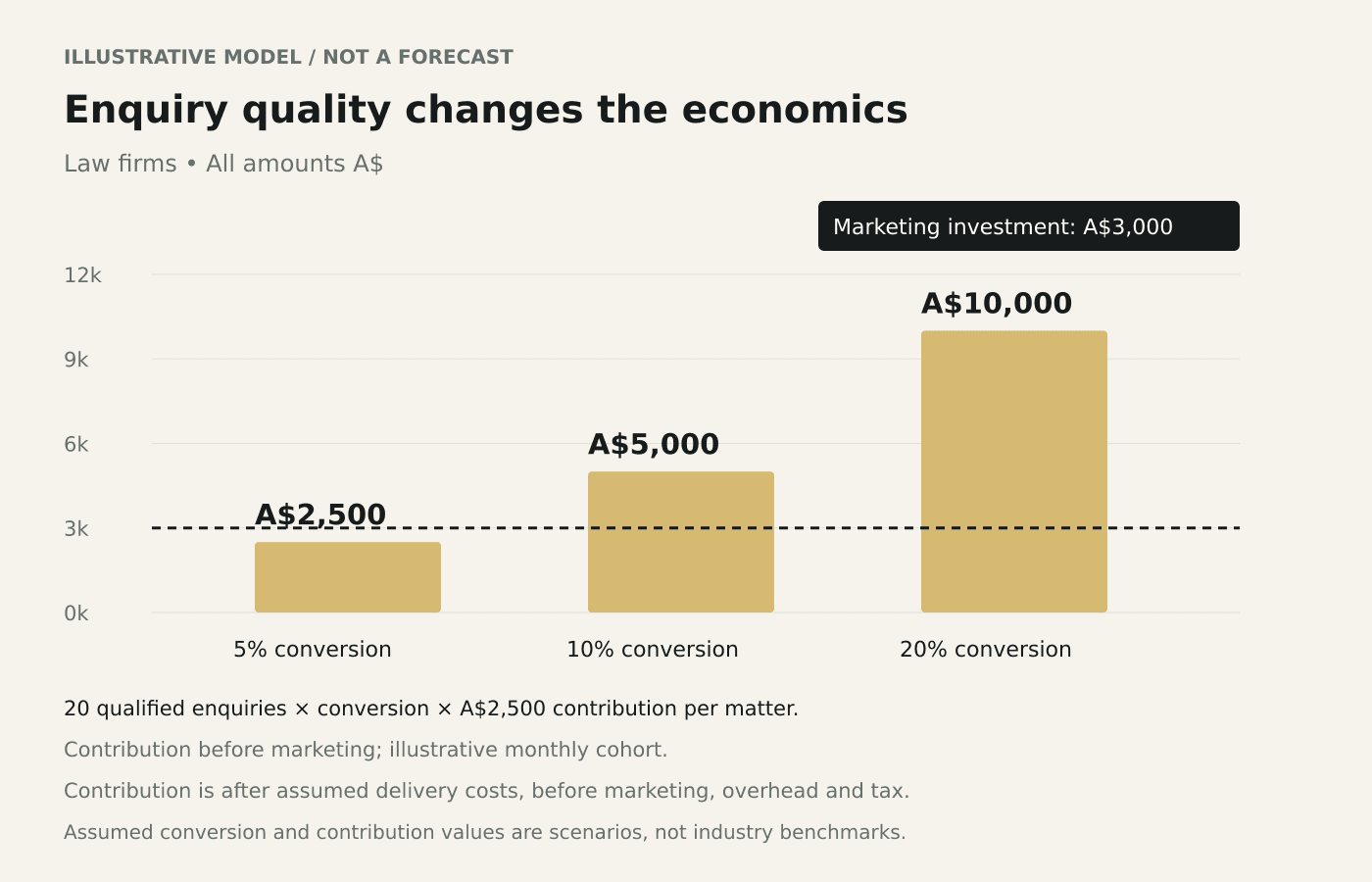
20 qualified enquiries × conversion × A$2,500 contribution per matter. Contribution before marketing; illustrative monthly cohort. These are assumptions, not results or benchmarks.
Create a measurement system the partners can trust
A manageable dashboard follows the journey: relevant visibility, visits to priority pages, enquiries, qualified enquiries, consultations where applicable, engaged matters and realised commercial outcomes. Agree definitions first. Otherwise one person will count every voicemail while another counts only signed engagements.
Ask new clients how they first heard about the firm and what helped them choose it. Store the answer alongside, not instead of, digital attribution. A person may discover you through an AI answer, later search your name and finally telephone. A last-click report can miss that sequence, while self-reported attribution can be incomplete too.
For AI monitoring, choose a fixed set of realistic prompts by practice and jurisdiction. Record the date, platform, response and any cited URL. Repeat consistently, noting that answers vary. Do not publish a sweeping market-share claim from a handful of favourable screenshots.
Our guide to monthly SEO reporting explains how to keep business outcomes central. A partner should be able to ask what changed, what evidence supports it and what the team will do next, without needing to decode a hundred metrics.
A practical first-quarter plan
In the first month, audit intake and the pages tied to the firm’s priority matters. Confirm where measurement works, what counts as a suitable enquiry and which claims need correction. Interview the people who answer the telephone. Their recurring questions are often more useful than a long list of suggested keywords.
In the second month, improve the highest-priority service and lawyer pages, then publish a small group of carefully reviewed supporting answers. Assign an owner to every article. Introduce approved image choices, accessible layouts and links that help a reader move to the right next step.
In the third month, review actual enquiry quality and the implementation backlog. Compare practice groups rather than averaging them together. If people reach a page but misunderstand the service, improve the page. If appropriate enquiries arrive but stall, inspect response and qualification before blaming the channel.
This is a sequence of work, not a promise of results within ninety days. Some firms need to fix fundamental site problems first; others have strong foundations but weak differentiation. The plan should respond to evidence rather than force every firm into the same publishing quota.
Build a discoverable firm, not an AI persona
The strongest strategy is specific: accurately describe the work, show who is responsible, publish genuinely useful explanations and make the next step clear. National or international reach should follow real capability, not a collection of near-identical location pages.
Creato can help connect the website, content and measurement work through our SEO services and AEO and GEO services.
If your firm wants a more qualified pipeline, talk to Creato about your practice priorities and current enquiry journey. Start with the matters you want to win and the evidence you already have. Better visibility matters most when it helps the right prospective client understand why you may be the right firm.
For further practical reading, browse the Creato blog.


