Published
Author

Callum
Categories
AEO & GEO


Ready to take it a step further?
Let's start talking about your project or idea and find out how Creato can help your business grow.
Two warehouses with similar roofs can need very different solar proposals. One operates heavily through the day; the other sits quiet while its largest loads run at night. Put the same system on both and the commercial story can change completely.
Commercial solar buyers need someone who understands that distinction. Unfortunately, many installer websites begin with panel counts, a generic savings claim and a request for a phone number. They leave the difficult questions about consumption, tariffs, roof suitability, ownership and connection constraints until much later.
That creates an opportunity for a better approach to SEO and AI search. Instead of competing only for broad “solar installation” traffic, make your business discoverable for the questions a facilities manager, business owner or finance team asks before approving a project.
The goal is not the largest possible lead list. It is more suitable feasibility conversations, with the right information available early enough to reduce wasted quoting and misleading expectations. This guide explains how to build that system without promising rankings, savings or project returns you cannot substantiate.
Think in load profiles, not just search volume
Begin with the commercial customers you can serve well. A cold-storage facility, a daytime workshop, an office building and a leased retail premises do not necessarily have the same decision process. Identify the operating characteristics and procurement arrangements that make an enquiry worthwhile for your business.
The Australian Government’s solar system sizing guidance identifies electricity use and timing, roof area, tariffs, climate and budget as relevant considerations. Its guidance is a useful Australian reference, not a universal design prescription.
Your content should reflect those variables. A guide for daytime manufacturers can discuss the information needed to assess self-consumption. A guide for tenants can explain the commercial questions to resolve with the property owner. A multi-site business may need a consistent assessment framework rather than a single rooftop quote.
These are not claims that one customer category always offers better returns. They are distinctions that help buyers understand whether your team is equipped for their situation. Validate the priority segments against completed projects and lost proposals, not an assumption that the highest electricity bill automatically makes the best lead.
Ask sales and engineering colleagues which missing facts most often change a proposal. Those answers should shape both your search content and your enquiry form.
Separate visibility from being selected
An AI answer can introduce an installer, cite an explanatory page or help a buyer formulate a question. None of those events proves that the business has been technically evaluated or that a project is commercially viable.
Google says its established SEO practices remain relevant to AI features. Treat visibility as a chance to enter a buying conversation, not a certification of your proposal.
Check crawler access with the website team. OpenAI documents separate controls for search and model-training crawlers. Make those choices deliberately rather than assuming a general AI block has no effect on discovery.
Creato’s guide to appearing in Google AI Overviews provides broader background. The commercial solar work is more specific: publish clear, technically reviewed answers that connect the buyer’s operational situation to the information needed for a responsible assessment.
Organise the website around the investment decision
A useful commercial solar website should serve at least four roles in the buying group. The business owner wants to know whether the project merits attention. Facilities staff need to understand site implications. Finance needs assumptions and sensitivities. Procurement needs a credible provider and a comparable scope.
Create an overview page that explains the assessment process, then supporting pages for genuinely different applications. Possible topics include solar for owner-occupied warehouses, multi-site commercial portfolios, and businesses investigating solar alongside electrification. Publish only where you can contribute relevant experience.
Keep commercial and residential enquiries distinct. The information required, buying group and proposal process may differ. Sending every visitor to the same “get a free quote” page makes it harder to qualify either audience and obscures which activity is producing valuable work.
Explain your geographic coverage honestly. A company serving several regions should describe how design, installation and maintenance are delivered in each. International audiences need country-specific guidance on approvals, incentives and electricity arrangements, not a page that silently treats Australian conditions as universal.
Do not create hundreds of interchangeable city pages. A smaller number of pages with real local delivery evidence is more useful than a national map of claims the business cannot support.
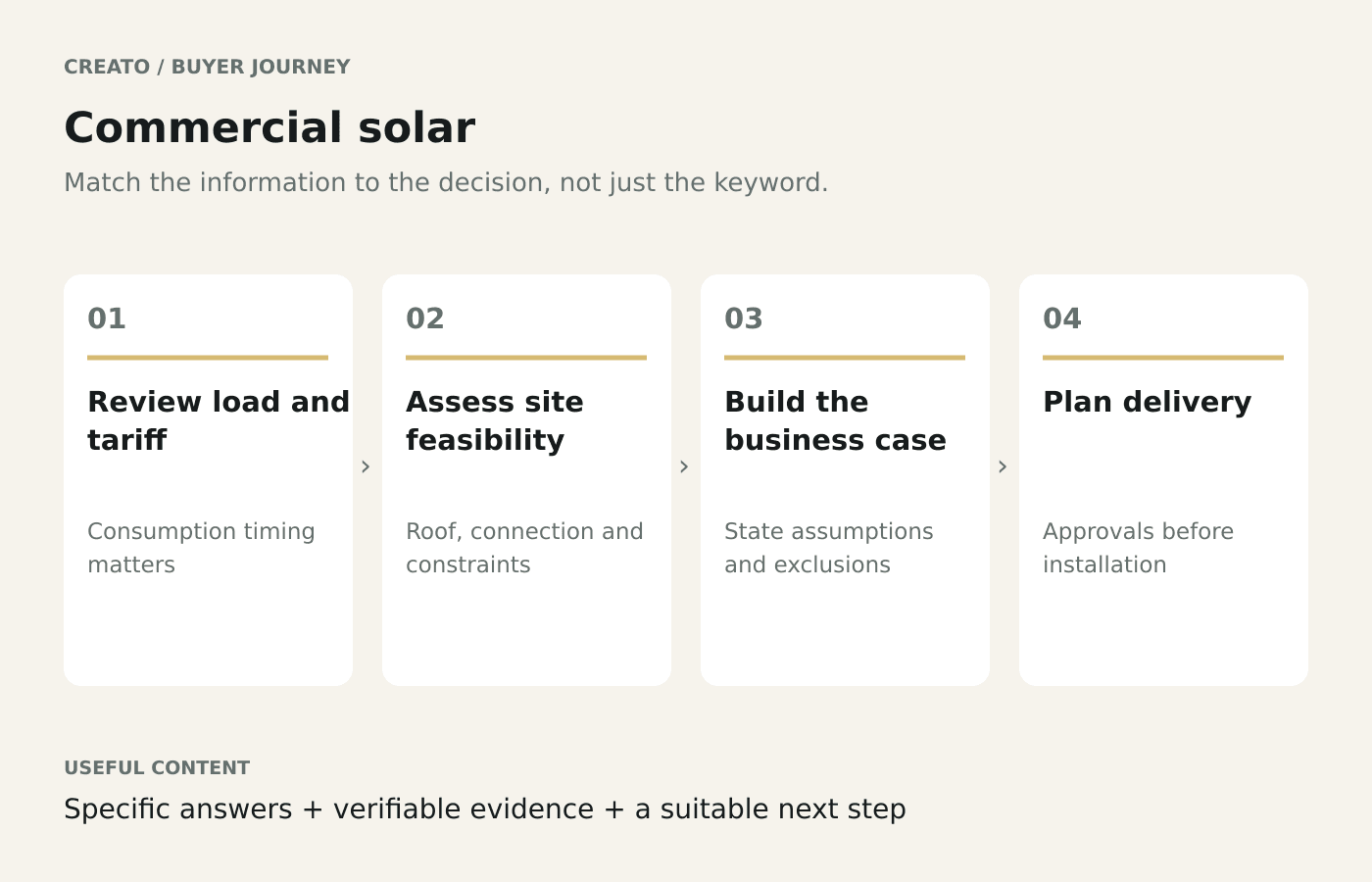
A practical content-planning framework. Real buying journeys may loop or involve several decision-makers.
Publish the questions that stop proposals progressing
Start with questions your team can answer without pretending to perform site engineering online. What electricity information is useful? Why might a roof assessment be needed? Who needs to approve work in leased premises? What happens if the business expects its load to change?
Give a short answer first, then explain what makes the answer conditional. For example, “How much solar fits on our roof?” should not end with a simple area formula. The useful response explains that an assessment considers usable area and site-specific design constraints, then identifies the next information to gather.
A comparison of outright purchase, financing and a power purchase agreement can be helpful if it discusses ownership, operating responsibilities, term, commercial assumptions and professional advice. Do not imply one route is always cheapest or quote financing terms that have not been verified for the relevant customer and market.
Similarly, a battery article should explain the question it is helping to answer. Peak demand, backup requirements and energy shifting are different objectives. Avoid presenting a battery as the automatic addition that makes every solar project better.
For Australian readers, government guidance on monitoring solar illustrates why generation and self-consumption need attention after installation. Use that as a prompt to explain your own monitoring and handover scope accurately, not to imply that every installation includes the same service.
Show the evidence behind a project case study
A photograph of a large roof establishes scale, not performance. A useful case study explains what problem the client was trying to solve, what your team delivered, and what evidence supports the result.
State whether energy and financial figures are modelled or measured. If measured, identify the period, source and important limitations. If modelled, describe the assumptions and do not present projected savings as achieved savings. Avoid comparing a partial year with a full year without explaining the adjustment.
Where permitted, include the operating pattern, system scope, commissioning date, monitoring arrangement and relevant constraints. Attribute design, engineering and installation roles accurately. Obtain client permission before publishing site details, bills, interval data or operational information.
A clear before-and-after chart can be powerful, but it should survive scrutiny. Weather, changes in production, tariffs and operating hours can affect the comparison. If those factors are not controlled, say that the chart is descriptive rather than proof that the installation alone caused every change.
For businesses without permission to publish performance data, document the process instead. Explain the assessment, coordination and handover. A truthful account of competent delivery is more persuasive than an unsupported “up to” savings headline.
Design enquiry forms for assessment, not interrogation
The first form should establish whether a conversation is worth having. Useful fields may include the site region, business type, ownership or tenancy status, project objective and a broad indication of electricity use. Make clear which information is optional.
Offer a secure route for bills or interval data at the appropriate stage. Do not demand sensitive operational material through a poorly explained upload field before the prospect knows who will access it. Describe the purpose and retention approach, and avoid collecting information your team will not use.
For multi-site enquiries, allow the buyer to say that a portfolio assessment is required. A form designed around one street address can accidentally exclude a valuable procurement conversation.
State what follows submission: an initial fit discussion, a request for further information or a feasibility review, according to your actual process. Do not promise a fixed engineering result or installation date before the necessary checks.
If people routinely abandon the form, improve clarity before buying more visitors. Creato’s website conversion guidance is a useful starting point for connecting content with a workable enquiry journey.
SEO versus ads for commercial solar
Paid search can quickly test a precise message for a defined audience. It can also spend money attracting household enquiries, job seekers and people researching subsidies rather than a commercial installation. Campaign segmentation and qualification matter more than celebrating the cheapest form completion.
Use separate landing pages where the audience and offer genuinely differ. A warehouse owner investigating feasibility should not land on a page dominated by residential package pricing. Review the actual search terms and the outcomes of the resulting conversations before increasing spend.
SEO has a different role. Detailed application pages, project evidence and decision guides can support buyers throughout a longer evaluation. They remain useful when someone first hears about you from an industry contact or a tender invitation and then researches your capabilities.
Neither channel removes the need for a technically competent proposal. Nor is SEO a cost-free alternative to advertising. Technical maintenance, expert review, content production and analysis require resources. A sensible comparison includes those costs and follows enquiries through qualification, proposal and won work.
A combined plan might use tightly scoped ads to test demand while improving the organic pages that answer recurring questions. Stop treating the channels as rivals if the real bottleneck is missing information, slow follow-up or proposals that do not fit the buyer’s situation.
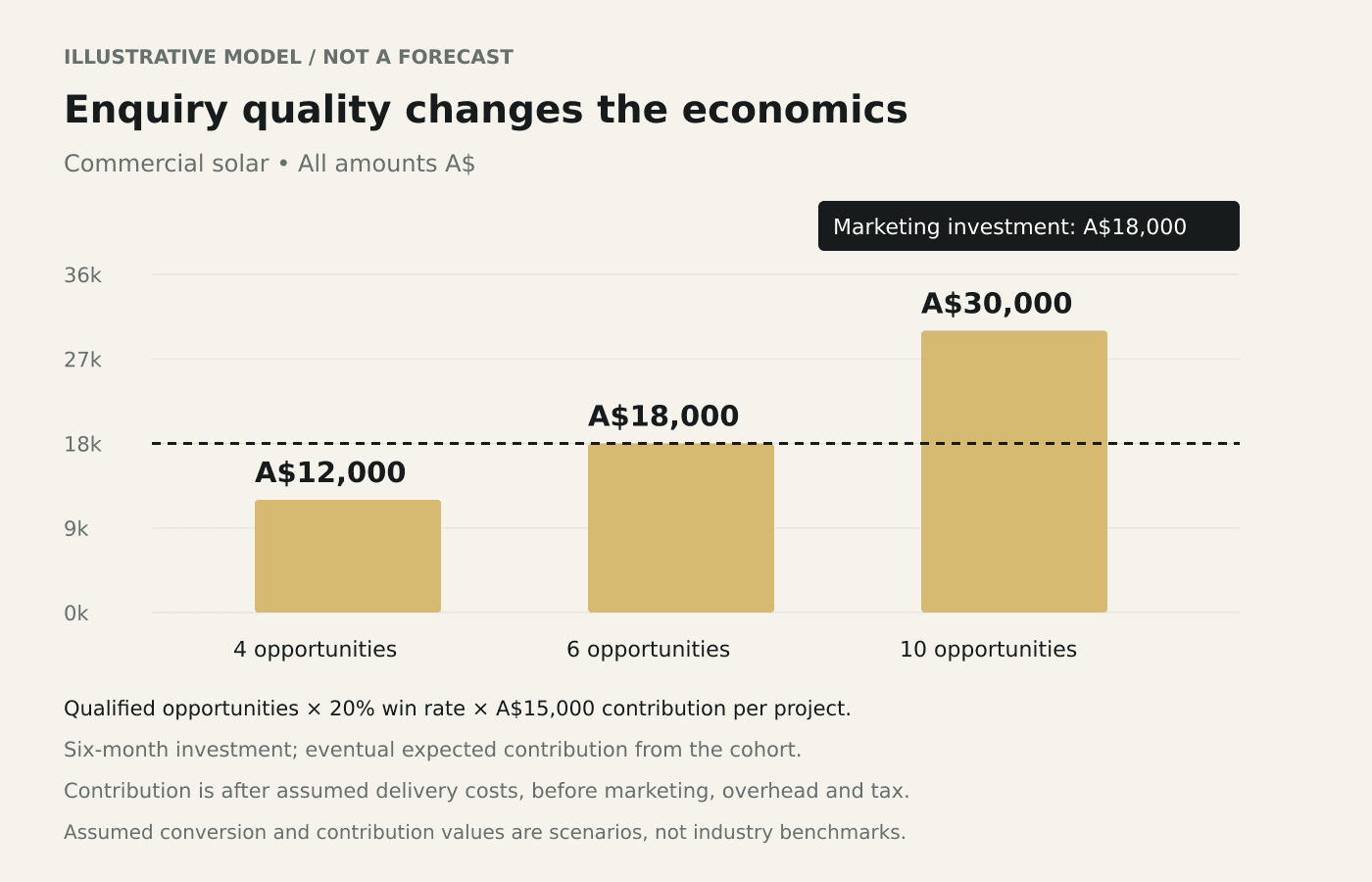
Qualified opportunities × 20% win rate × A$15,000 contribution per project. Six-month investment; eventual expected contribution from the cohort. These are assumptions, not results or benchmarks.
Model the installer’s economics, not the customer’s savings
There are two different financial stories in commercial solar. One concerns the customer’s energy project. The other concerns your business’s cost of acquiring profitable work. Do not use the customer’s projected lifetime bill savings as though that money were installer revenue.
Here is an illustrative acquisition model, entirely invented for planning. Assume A$18,000 invested over six months, A$15,000 contribution per won project after direct delivery costs, and a 20% win rate among genuinely qualified opportunities. These are not industry benchmarks, project quotations or Creato fees.
The expected contribution per qualified opportunity is A$3,000. Four qualified opportunities imply A$12,000 eventual expected contribution; six imply A$18,000; ten imply A$30,000. Compared with the A$18,000 acquisition investment, those scenarios are A$6,000 below, equal to, or A$12,000 above the investment before central overhead and tax.
The word “eventual” matters. A lead acquired during the six-month period may convert and be delivered later. Expected contribution is probability-weighted, not cash in the bank, and small samples can perform very differently. The model also assumes the contribution figure already captures the direct costs relevant to delivery.
Replace the assumptions with your own segment-level data. Include sales engineering and site assessment costs if they have not already been deducted. Track cancelled projects and variations. A higher-value project is not automatically a better acquisition if it consumes disproportionate assessment effort or produces a lower contribution margin.
Speak with Creato if you need the website, campaigns and CRM reporting to tell this commercial story consistently. The first useful deliverable is often a clearer measurement plan.
An implementation sequence that respects engineering time
Begin by choosing one commercially important segment and auditing its existing journey. Find the page buyers land on, the information they receive, the form they submit and the questions sales asks afterwards. Fix contradictions and missing information before expanding the content library.
Next, interview the people who assess and deliver projects. Build a small question bank from real objections and scope changes. Ask a technical reviewer to approve the answers, particularly where the wording could be mistaken for design advice or a financial guarantee.
Publish a substantive segment page, one permitted project example and two decision guides. Link them naturally. Give each a distinct purpose rather than repeating the same explanation with different keywords. Use diagrams to clarify an assessment workflow, not decorative stock imagery alone.
Then check whether the content improves conversations. Are buyers supplying better information? Are unsuitable enquiries being identified sooner? Do proposals progress more efficiently? Track search visibility as a leading indicator, but make qualified opportunities and actual project contribution the commercial scorecard.
Frequently asked questions
Should we publish solar prices online?
You can explain the factors that influence price and the scope required for a quote. Any published example should identify its date, market, assumptions and exclusions. Avoid an apparently universal price that sales must immediately withdraw once the site is assessed.
Can we rank nationally if we install in only one region?
Your educational content can reach a national audience, but service claims must reflect actual delivery coverage. Make the distinction clear. Otherwise national traffic can create enquiries you cannot fulfil and leave buyers confused about where your crews operate.
Do we need a separate page for every system size?
Only if the page answers a genuinely different need with useful information. A large collection of size-based pages with almost identical text is unlikely to help a buyer assess site suitability. Application, ownership and operational context may be more meaningful distinctions.
What should an AI visibility report show?
It should identify the prompts tested, dates, location context, whether the business was mentioned or cited, and which pages appeared. It should also explain limitations. A handful of favourable answers is not a market-share measurement or proof of qualified demand.
How do we prove our marketing works?
Connect enquiries to qualification, proposals, won projects and contribution where your records permit it. Preserve source information and ask buyers how they found you. Keep measured performance separate from expected pipeline value, and allow for the time between initial enquiry and completed installation.
Become the installer that makes the decision clearer
Commercial buyers do not need another page promising that solar pays for itself. They need a provider who understands their operating conditions, explains assumptions and can deliver a properly scoped project.
That is the foundation of a useful AI search strategy: clear expertise, accessible evidence and an enquiry process that respects the complexity of the purchase. Explore Creato’s SEO service approach and AEO and GEO services, or discuss your commercial solar market with us. We can help organise the evidence and journey without substituting marketing claims for engineering judgement.
For more practical guidance on search, websites and measurement, explore the Creato blog.


