Published
Author

Callum
Categories
AEO & GEO


Ready to take it a step further?
Let's start talking about your project or idea and find out how Creato can help your business grow.
A sloping block can change a building conversation before anyone chooses a kitchen. Access, ground conditions, retaining, drainage and the way the design sits on the site all affect what is actually being priced. Yet many custom builders’ websites still lead with the same three words: quality, luxury and craftsmanship.
Those words do not help a prospective client decide who can build on their particular block. They also give an AI search system little substance to distinguish one builder from another.
For a custom builder, appearing in ChatGPT or Google’s AI answers should not mean attracting every person browsing beautiful houses. The commercial objective is more specific: become discoverable to owners whose site, budget, delivery model and expectations match the homes you genuinely build. Then give those owners enough evidence to start an informed conversation.
This guide sets out an evidence-led approach to SEO, answer engine optimisation and generative engine optimisation for custom home builders. It applies across markets, while recognising that licensing, approvals, construction terminology and customer protections differ by jurisdiction.
Start with the questions an estimator would ask
Your best search strategy may already be sitting in your estimating inbox. Look at recent enquiries that became worthwhile projects, the enquiries that consumed weeks without proceeding, and the questions your team asks before offering meaningful advice.
Does the client own the land? Is the design preliminary or documented? Are they seeking a design-and-build service or asking you to price an architect’s drawings? Is the stated budget construction-only or intended to include demolition, consultants, approvals, landscaping and contingencies? What is known about access and the site?
Turn those distinctions into your website architecture. A page about building on a constrained site serves a different need from a gallery of large family homes. An explanation of early builder involvement serves a different buyer from a tender enquiry page. Combine them only if the business really delivers both services and can explain their relationship.
The Australian Government’s Your Home guide to building a house treats builder selection as part of a wider design, approvals, contract and construction process. That supports an important marketing principle: answer the decisions around the build, not just the final aesthetic.
Interview a director, estimator and site supervisor separately. Their answers will expose different buyer concerns. The director knows suitable projects; the estimator knows missing information; the supervisor knows which promises create problems on site. An article reviewed by all three is harder to imitate than another generic list of home-building tips.
What ranking in AI search actually means
AI visibility is not a single league table. A builder can be named in an answer, have a project page cited, or receive a visit after someone asks a follow-up question. Those events have different commercial value and should not be bundled into one impressive-looking number.
Google’s guidance says normal SEO remains relevant to its AI features; inclusion is not guaranteed. Treat AI optimisation as clearer evidence and stronger discoverability, not a replacement for a useful website.
For ChatGPT search, review access controls with your developer. OpenAI distinguishes its search crawler from its training crawler. A training preference should not be confused with a search visibility strategy.
Creato’s explanation of SEO, AEO and GEO covers the broader terminology. For builders, the practical work is choosing the right questions and publishing answers grounded in real delivery experience.
Build around four distinct buying situations
First, serve the owner investigating feasibility. They need to understand whether their block, aspirations and budget belong in the same conversation. Explain what information helps an initial discussion and when specialist advice is needed. Avoid an instant price calculator that hides more assumptions than it reveals.
Second, serve the owner choosing a delivery approach. Explain the practical differences between bringing completed drawings, working with an independent architect, and using your design-and-build process. Make responsibilities visible. Do not imply you provide architectural services or certifications that your team does not hold.
Third, serve the owner comparing builders. They need comparable project examples, a credible description of communication, and clarity about how scope is developed. This is where detailed case studies outperform a rotating wall of photographs.
Fourth, serve the owner ready to enquire. Give them a straightforward route to submit a brief, project location, indicative budget range and current stage. Explain what happens next without inventing a response or construction deadline.
These situations can produce useful queries such as “builder experienced with narrow access”, “custom builder working with my architect” and “what information does a builder need to quote”. Treat these as research hypotheses. Validate them against enquiry language and search data rather than presenting them as measured high-volume keywords.
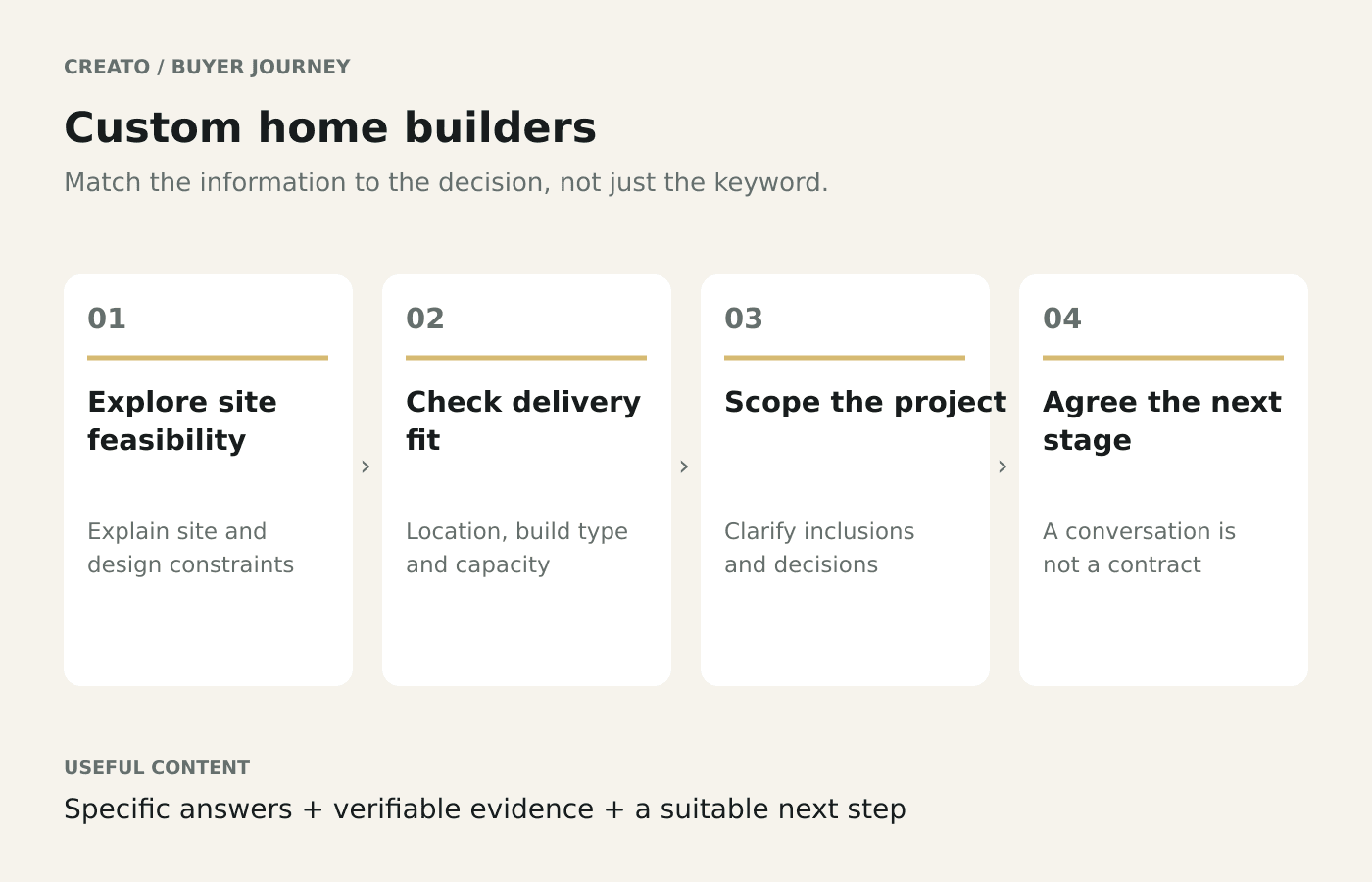
A practical content-planning framework. Real buying journeys may loop or involve several decision-makers.
Make project pages do technical work
A useful project page explains a constraint, a decision and its consequence. Instead of “a stunning contemporary residence”, describe how the team accommodated restricted access, protected an existing tree, sequenced a difficult structure, or coordinated a particular envelope detail.
Use only facts the project team can verify and the owner has permitted you to publish. A private house is not an open invitation to disclose an address, floor plan, security arrangement or client budget. Generalise the location where necessary and preserve the information that demonstrates competence.
A strong structure includes the project type, your role, the brief, the site challenge, the approach, selected construction details and a result supported by records. Distinguish the architect’s work, the builder’s work and specialist contributions. Shared credit is more credible than claiming every achievement yourself.
Where performance is measured, explain the measurement. A design rating, a certification and an owner’s impression of comfort are not interchangeable. Where no measurement exists, describe the completed work without manufacturing a number.
Original progress photographs can be particularly valuable. An annotated image showing a construction decision teaches more than a polished living-room photograph alone. Include descriptive captions, obtain photography rights and explain the detail in text so the page remains understandable without the image.
Answer cost questions without turning estimates into promises
Builders understandably hesitate to publish prices. But silence pushes clients towards simplistic cost-per-square-metre answers that may not fit the project at all.
Publish a guide to the variables instead: site preparation, structural complexity, specification level, access, documentation quality and what the stated scope excludes. Explain what your team needs before a useful estimate can be produced. If you publish indicative ranges, date them, identify the market and scope, and have the estimator approve them.
The Australian Government’s guidance on choosing a site discusses constraints including slope, ground conditions and easements. It is a useful reference for an Australian example, not a substitute for advice about a particular property elsewhere.
Discuss allowances carefully. Explain in plain English that an allowance is not the same thing as a fully selected and priced item, while referring contract-specific interpretation to the relevant professional. The goal is a better-prepared enquiry, not amateur legal advice.
An honest cost page can also state when you are not the right fit. If the business does not undertake small alterations or works only within a defined construction budget, say so respectfully. Fewer unsuitable enquiries can be a positive result.
Keep geography real, even with a national strategy
A national audience does not require a national construction promise. Your marketing guide can reach builders anywhere; an individual builder’s website must accurately describe where its crews and subcontractor relationships can support delivery.
Create location pages only where you can add useful evidence. Show relevant projects, actual service coverage, environmental considerations and the delivery model. Do not swap suburb names across otherwise identical pages or invent offices to appear more local.
For international work, explain whether you act as the builder, a design partner, a project manager or a supplier. The distinction matters. An overseas project enquiry has little value if the prospect thinks you provide licensed construction in a market where you do not operate.
Keep business details and team biographies consistent. A buyer who moves from a referral to a search result to a project page should encounter the same business identity and a believable account of its expertise.
SEO versus advertising: compare qualified opportunities
Paid search can test demand for a particular project type while organic content develops. It is also useful when you have a specific capacity gap and a genuinely relevant landing page. But broad advertising for “home builders” may attract volume-home shoppers, job seekers, suppliers and people far outside your service area.
Separate campaigns by the work you want, review search terms, and judge them by qualified conversations rather than raw form completions. A completed form with no land, an incompatible budget and an unrealistic programme is not equivalent to a suitable documented project.
SEO builds a discoverable body of project evidence and explanatory content. It is not free: someone must gather facts, write, design, maintain and measure it. Nor does organic traffic arrive on a contractual schedule. A sensible plan can use ads for immediate testing and SEO to improve the evidence available throughout the buying process.
Do not compare one month of advertising spend with one month of SEO activity and declare a winner. Custom builds have long consideration periods. Follow enquiry cohorts through scoping and contract, and record where people first heard about you as well as the last click before contacting you.
If that measurement is missing, talk to Creato about the website and enquiry journey before buying more traffic. A better-qualified pipeline matters more than an attractive dashboard.
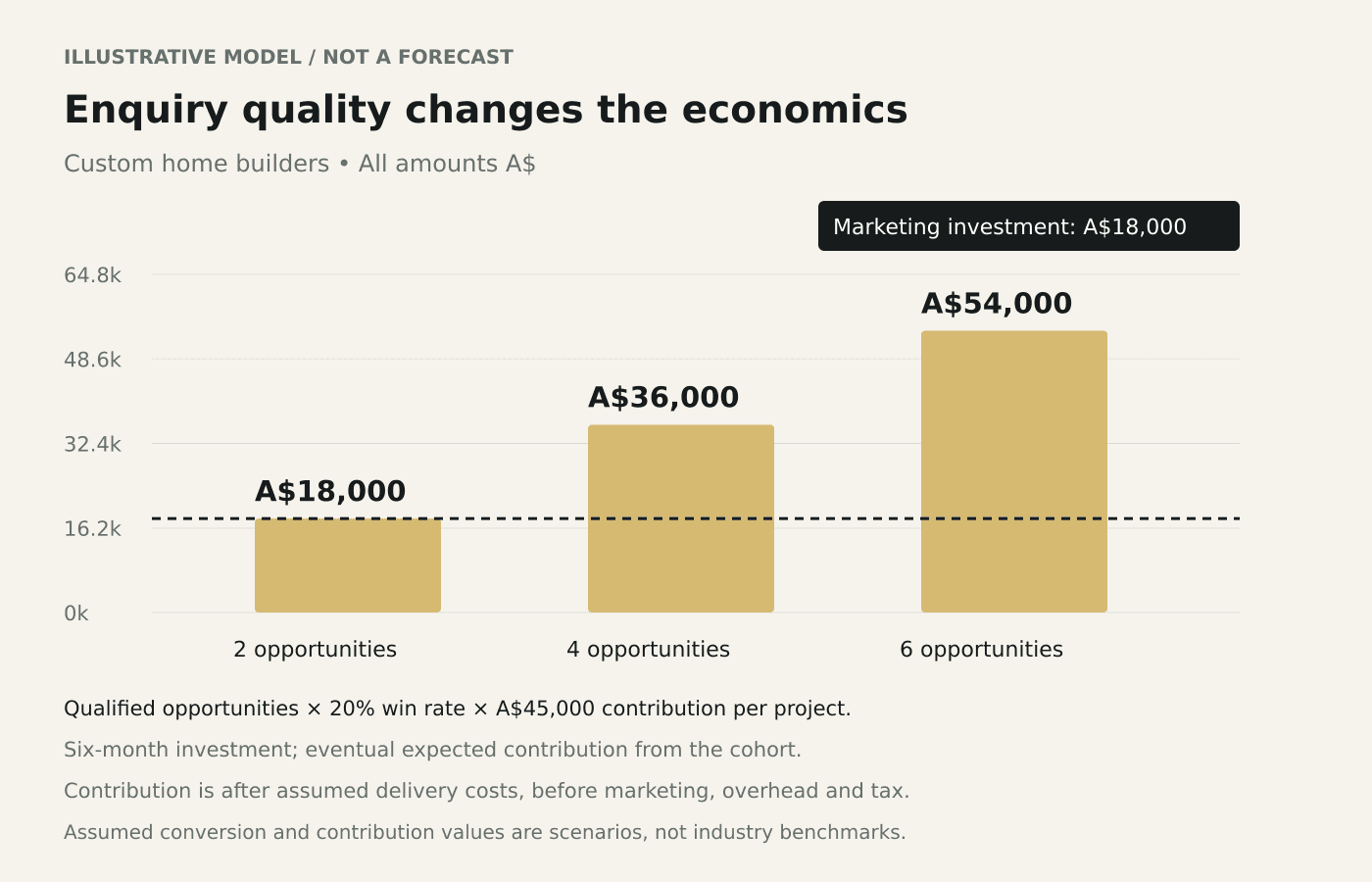
Qualified opportunities × 20% win rate × A$45,000 contribution per project. Six-month investment; eventual expected contribution from the cohort. These are assumptions, not results or benchmarks.
An illustrative investment model, not a revenue promise
Consider an entirely hypothetical builder investing A$18,000 in acquisition work over six months. This is a planning example, not a Creato fee or industry benchmark. Assume each won project contributes A$45,000 after direct delivery costs and before central overhead and tax. Assume one in five qualified opportunities eventually becomes a project.
Under those assumptions, a qualified opportunity has an expected contribution of A$9,000: A$45,000 multiplied by 20%. Two opportunities produce A$18,000 expected contribution; four produce A$36,000; six produce A$54,000. Subtracting the acquisition investment leaves A$0, A$18,000 and A$36,000 respectively before other costs.
Those are probability-weighted scenarios, not fractional houses or cash already earned. The projects may convert and be delivered after the six-month acquisition period. A small sample can produce no wins, and a cancelled or poorly scoped project changes the economics substantially.
Replace every assumption with your own records. Separate enquiry-to-qualified-opportunity conversion from qualified-opportunity-to-contract conversion. Include estimating time and preconstruction costs that the contribution assumption has not captured. If your business cannot absorb another project, a forecast of additional enquiries is not automatically a growth opportunity.
The useful question is not “how much traffic will this buy?” It is “what contribution would appropriately qualified work need to produce, and how will we know whether it did?”
A practical first ninety days
In the first month, audit existing enquiries and choose two project types the business wants more of. Check that their pages can be found, understood and used on mobile. Test the enquiry form and routing. Record a baseline of qualified opportunities, not just total sessions.
In the second month, publish one substantial project case study for each chosen type and answer the most common feasibility questions. Improve internal navigation between those pages, your process page and the enquiry form. Update existing pages before creating a large library of overlapping articles.
In the third month, review real conversations. Which page helped an owner understand fit? Which questions still arrive unanswered? Which traffic source produces unrealistic expectations? Refine the content and, if appropriate, test a tightly scoped paid campaign.
Maintain a small set of realistic AI search questions and record the date, platform, location context and cited pages when checking visibility. Treat that record as directional research, not proof that every prospective client sees the same answer. Contracts and qualified briefs remain the commercial evidence.
Frequently asked questions
Do custom builders need hundreds of blog posts?
No. A smaller collection of useful service pages, credible project examples and clear explanations can be more valuable than hundreds of shallow articles. Start where your team has experience and buyers repeatedly need help. Expand when there is a distinct question and a credible answer.
Should every project have its own page?
Only when it contributes useful evidence and you have permission to share it. A project with a distinctive constraint or delivery approach deserves explanation. Several nearly identical galleries may be better organised into a strong portfolio category with selected detailed examples.
Can an AI mention replace local referrals?
No. A referral can initiate the relationship while search helps the owner validate it. Your website should make that validation easier. Ask new clients about both referrals and online research instead of forcing the whole journey into a single channel label.
Is structured data enough to appear in AI answers?
No. Accurate structured data can describe visible content, but it does not create expertise, project evidence or buyer relevance. Never mark up invented ratings, client results or services. Technical work should support the substance already present on the page.
What should we ask an SEO agency to report?
Ask for work completed, pages improved, relevant search visibility, qualified enquiries, reasons for disqualification and progression towards contracts. Request a clear distinction between observed results and projections. The agency should explain what it can measure and what remains uncertain.
Build a website that earns the next conversation
Custom building is a judgement-intensive service. Your strongest marketing asset is not a claim to be premium; it is evidence that you understand the decisions, constraints and trade-offs a client is about to face.
Creato can help turn that expertise into clearer service pages, stronger project stories and a measurable enquiry journey. Explore our SEO service approach across Australia and AEO and GEO service approach, or get in touch to discuss your actual market and project mix. The starting point is fit, evidence and a practical plan, not a promise to appear in every AI answer.
For more practical guidance on search, websites and measurement, explore the Creato blog.


