Published
Author

Callum
Categories
AEO & GEO


Ready to take it a step further?
Let's start talking about your project or idea and find out how Creato can help your business grow.
“Can you hold that tolerance?” is rarely the whole question. A useful answer also depends on the material, geometry, process, quantity, inspection requirement and what the drawing actually specifies. A manufacturer knows this. A website that says only “precision engineering to the highest standards” tells a buyer almost none of it.
Industrial search marketing works best when it reflects how technical purchasing happens. The goal is not to attract everyone interested in manufacturing. It is to help a design engineer, production manager or procurement specialist recognise that your capabilities may fit a real requirement, then give them a credible path to an RFQ.
AI search adds another discovery surface, but it does not remove technical qualification. A recommendation in an answer cannot validate a drawing, reserve capacity or approve a supplier. Your website must carry the conversation beyond the initial mention.
This guide focuses on B2B manufacturers supplying components, assemblies and production services. It covers national and international discovery while keeping process capability, confidentiality and commercial fit at the centre.
Use the language of a real sourcing brief
Start with the information your estimating team needs to decide whether an RFQ belongs on its desk. That may include material, process, dimensions, critical tolerances, finish, batch size, annual demand, inspection documentation and delivery destination.
This is not just a marketing theory. The US National Institute of Standards and Technology’s supplier scouting request asks for technical and commercial details including manufacturing process, tolerances, materials, certifications, volume and delivery requirements. It is a US sourcing example, but the underlying distinction between capability and commercial fit is useful internationally.
Your website should answer enough of those questions to help a buyer shortlist you accurately. A machine list alone is insufficient. It identifies equipment, not necessarily the work you want, the expertise available or the conditions under which a particular result is achievable.
Interview estimating, production and quality staff. Ask which enquiries are well matched, which consume time without progressing, and which capability is repeatedly misunderstood. Use those answers to decide what deserves a page and what should be stated as an exclusion.
The resulting content should sound like a technically competent supplier explaining its work, not an SEO agency inserting manufacturing adjectives into a generic template.
Separate process, material and application pages
A clear information structure helps buyers navigate from a broad need to a specific capability. Process pages can explain what you do. Material pages can discuss relevant experience and limitations. Application pages can show how those capabilities have been used in a particular type of component or assembly.
Do not create every possible combination simply because a keyword tool can generate it. Publish a dedicated page when the combination represents meaningful expertise and you have something useful to say. Otherwise organise the information within a stronger parent page.
For a machining business, a process page might describe the kinds of geometry and production work it handles. A supporting material page might explain relevant experience without promising universal machinability. An application example might show how inspection and documentation were managed for a permitted project.
For fabrication, the structure may instead centre on assemblies, materials, finishing and installation boundaries. For a contract manufacturer, the key distinction may be prototype development versus repeat production. Let the actual business model determine the structure.
Make handoffs visible. If finishing, heat treatment or testing is subcontracted, describe your role accurately. Buyers care about accountability and traceability; pretending every operation is performed in-house can create a damaging mismatch later.
Replace vague claims with bounded capability statements
A capability statement should be specific enough to help a buyer and qualified enough to remain true. Do not publish a single extreme tolerance or maximum envelope as though it applies to every material, geometry and production condition.
Explain which figures are general equipment limits, which describe typical work, and which require engineering review. Have production staff approve the wording. If a capability changes after equipment or staffing changes, update the page rather than leaving an impressive but obsolete number online.
Photographs and diagrams can help. Show an actual process, inspection setup or permitted component, with a caption explaining what the image demonstrates. Avoid suggesting that a stock photograph depicts your facility or that a staged illustration proves a production capability.
Where you offer design-for-manufacture input, describe the scope and timing. A buyer may need to know whether you can review a concept before a formal RFQ, whether that work is chargeable, and who retains responsibility for the design. State your actual process without inventing terms.
A precise limitation can strengthen credibility. Saying that a requirement needs review is more useful than a blanket claim that the factory can make anything. It also reduces RFQs your team cannot responsibly quote.
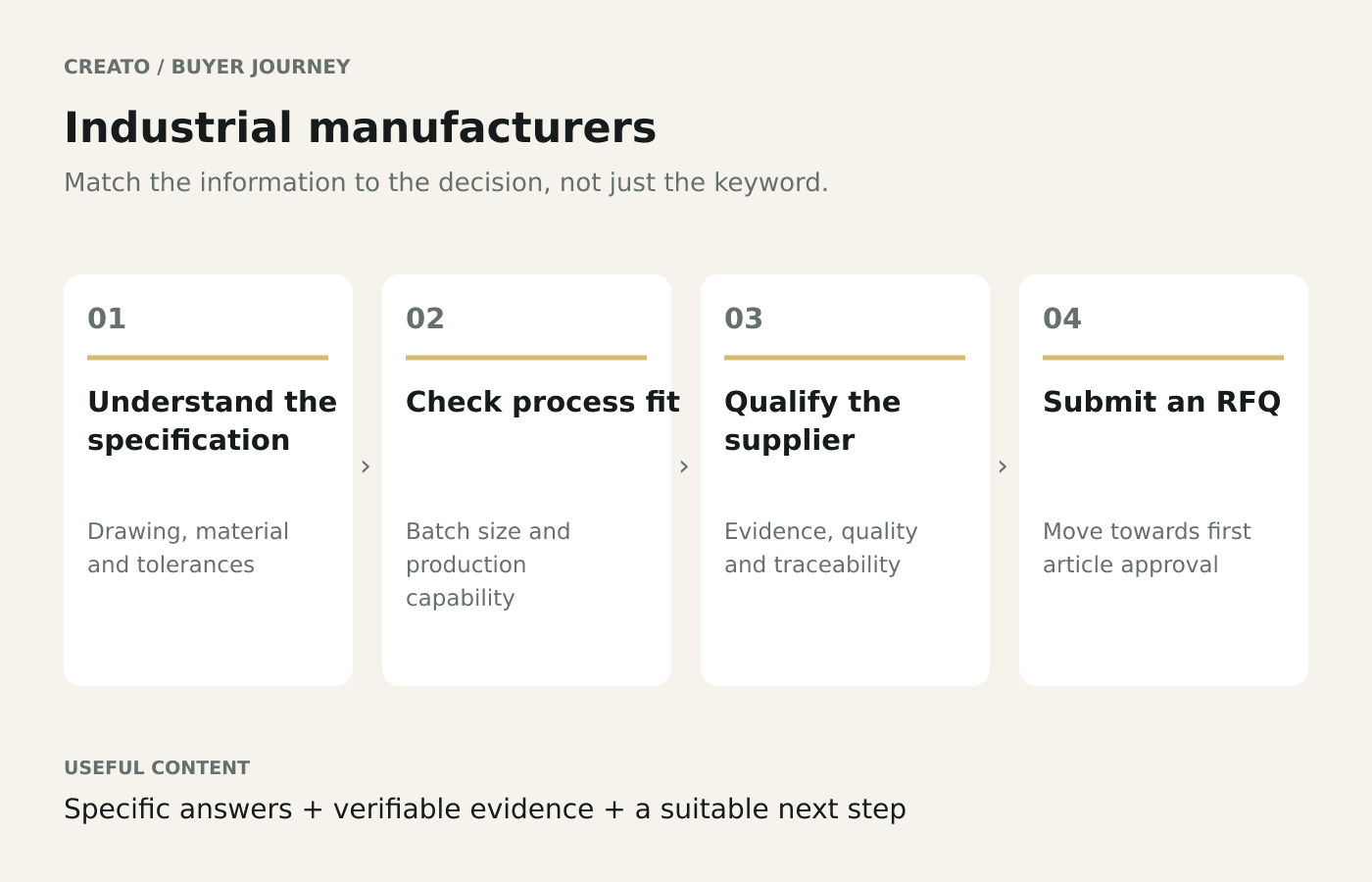
A practical content-planning framework. Real buying journeys may loop or involve several decision-makers.
Make quality evidence easy to verify
Quality pages should do more than display logos. Identify the relevant certification, the certified entity or facility, its scope and the route for verification. Check expiry dates and avoid implying that one site’s certification covers every operation in a group.
ISO’s certification guidance explains that ISO develops standards but does not itself issue certificates. Use accurate wording about certification bodies and never treat a management-system certificate as proof that every product has a separate product approval.
Describe inspection and documentation capabilities at a useful public level. If first-article reports, material traceability or other records are available, explain when they are specified and how they relate to the order. Do not imply that every possible document is automatically included.
Technical buyers may need more detailed evidence than should sit on a public webpage. Provide a clear controlled route for requesting it. Search visibility does not justify publishing customer drawings, proprietary processes, commercially sensitive pricing or restricted technical information.
A current, accurate quality page can help procurement validate a supplier already discovered through a referral or directory. That makes it commercially useful even when it is not the page that attracts the most organic traffic.
Write content that helps engineers make the next decision
Useful articles explain choices rather than merely define terms. A guide might describe the information needed to compare prototype and production quotations, the factors that make a drawing ready for an RFQ, or why inspection requirements should be stated before pricing.
Keep the advice within your expertise and avoid presenting a general article as approval for a specific design. Where a requirement depends on an applicable standard, contract or safety-critical application, direct the buyer to an appropriate technical review.
Use worked examples that are clearly hypothetical when they are not real projects. Show how a missing finish requirement or unclear revision can delay a quote, without fabricating a customer incident. The lesson should be practical: better information improves the conversation.
Answer the concise question first, then explain the conditions. A procurement specialist scanning on a phone and an engineer reviewing at a workstation both benefit from descriptive headings, readable diagrams and accessible text.
Do not hide all useful content inside brochures. A downloadable capability sheet can help internal circulation, but the essential facts should also be available on the relevant web page. Keep the brochure and website aligned so they do not describe different versions of the business.
Where AI visibility fits into industrial sourcing
A buyer may use an AI tool to understand a process, identify potential suppliers or organise evaluation criteria. Those are discovery tasks, not supplier approval. Your content should help at that stage without claiming that search visibility substitutes for due diligence.
Google’s guidance for AI features keeps established SEO fundamentals central. No visibility outcome is guaranteed simply because a page is technically eligible.
For ChatGPT search, OpenAI describes a dedicated search crawler. Review its access intentionally alongside your normal website controls, while keeping confidential material protected.
The practical opportunity is to make your capability evidence unambiguous and easy to navigate. Creato’s guide to ranking a business in ChatGPT covers the wider discovery context. For manufacturing, the differentiator is the quality of the technical and commercial information behind the claim.
Design an RFQ path that respects confidentiality
A short contact form can establish the nature of an enquiry, but a production RFQ often requires more information. Offer a sensible sequence rather than forcing every visitor through a long upload process immediately.
Ask for the process or component type, material, quantity range, destination and project stage where relevant. Explain how a buyer can provide drawings securely and whether an NDA process is available. Do not claim that uploading automatically creates an NDA unless the actual terms establish that.
Include a way to identify the drawing revision and desired documentation. Ambiguity here can create expensive back-and-forth. Avoid collecting sensitive information that is unnecessary for initial qualification, and make the handling process clear.
Separate jobs, supplier pitches and customer RFQs so they reach the right team. Test the form, file limits and confirmation flow using benign test data, not customer intellectual property. A well-ranked page is wasted if the attachment never reaches estimating.
Speak with Creato if your current website generates enquiries that cannot be routed or assessed efficiently. Improving the RFQ journey can be more useful than increasing raw traffic.
SEO versus advertising for manufacturers
Paid search can work well for a tightly defined process, material or service need. It can also attract hobbyists, students, job seekers and low-volume enquiries that do not fit your economics. Segment campaigns and landing pages around real commercial distinctions.
Avoid judging success by the cost of a form alone. A cheap enquiry for an unsuitable one-off part may be less valuable than a more expensive RFQ from a qualified buyer with a repeatable requirement. Equally, a large projected annual volume is not guaranteed business.
SEO supports a longer discovery and validation process. Capability pages, technical explainers and evidence can help a buyer who first encounters you at a trade event, through a distributor or from another supplier. Organic search is often part of that validation, not an isolated channel.
Compare acquisition efforts using qualified RFQs, quoting effort, awards and contribution. Include the cost of engineering review and samples where appropriate. A pipeline full of quotations is not necessarily a profitable pipeline if most requests are incompatible or unlikely to proceed.
A combined strategy can test precise demand with ads while building useful content around proven capabilities. The right mix depends on capacity, sales cycle, existing relationships and the work the business wants, not a universal rule that one channel always beats the other.
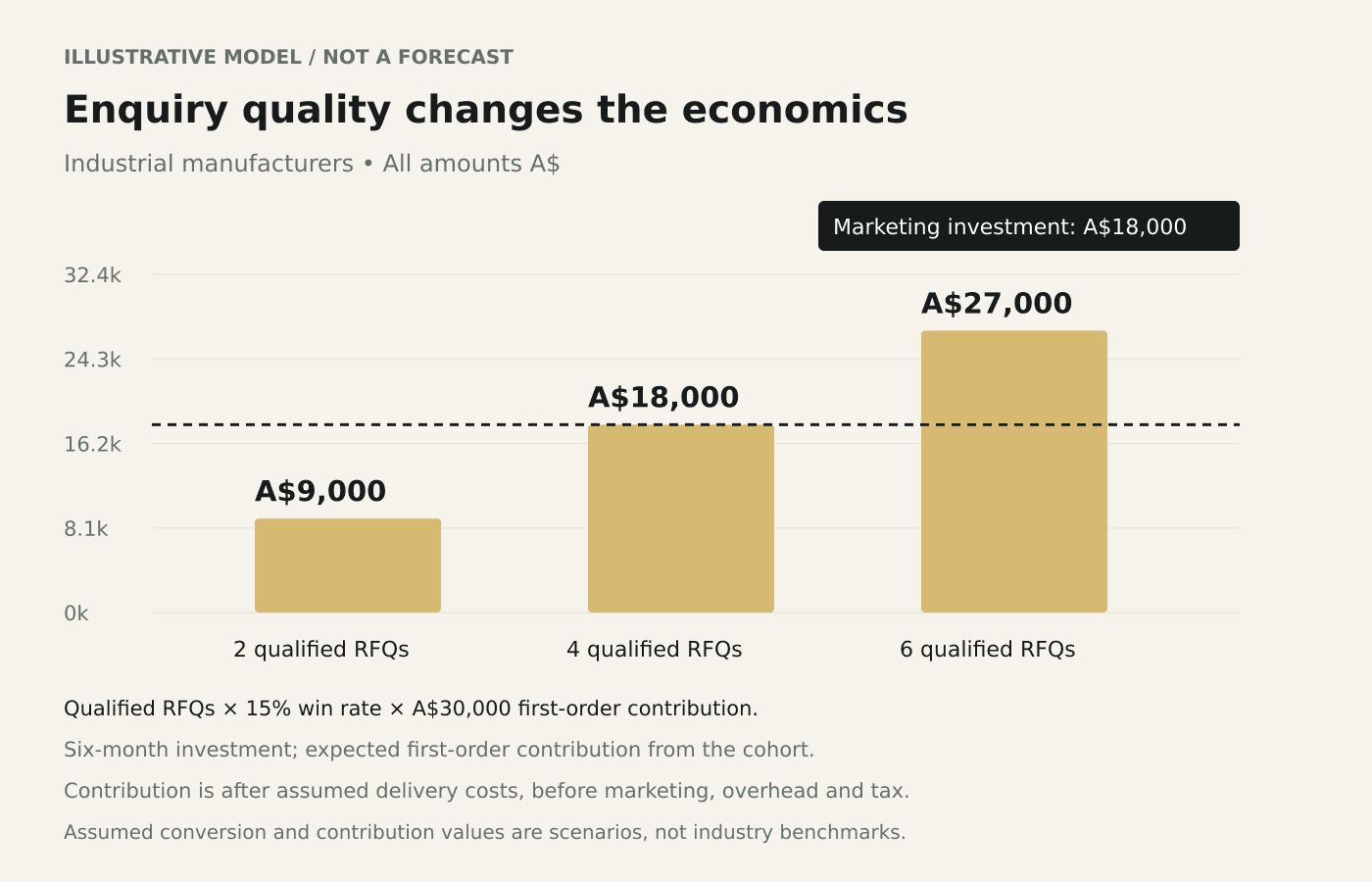
Qualified RFQs × 15% win rate × A$30,000 first-order contribution. Six-month investment; expected first-order contribution from the cohort. These are assumptions, not results or benchmarks.
An illustrative RFQ investment model
Assume a manufacturer invests A$18,000 in acquisition activity over six months. Assume a won first order produces A$30,000 contribution after direct production costs, and 15% of qualified RFQs eventually become first orders. These figures are hypothetical planning inputs, not manufacturing benchmarks, Creato fees or guaranteed outcomes.
Expected first-order contribution per qualified RFQ is A$4,500. Two qualified RFQs imply A$9,000 expected contribution; four imply A$18,000; six imply A$27,000. Against the acquisition investment, the scenarios sit A$9,000 below, at break-even, and A$9,000 above before central overhead, tax and any costs not included in contribution.
This is not a claim that a fraction of an order can be banked. It is a probability-weighted comparison, and a small set of RFQs can produce no awards. Orders may also be won and delivered after the six-month acquisition period.
Keep repeat orders separate until you have evidence for their likelihood and value. Do not turn a buyer’s estimated annual usage into guaranteed lifetime revenue. Likewise, include tooling, sampling, qualification and engineering costs wherever the contribution assumption does not already capture them.
Use the model to ask better questions. What makes an RFQ qualified? How much quoting effort is justified? Which market produces suitable repeat work rather than endless speculative quotations? Those decisions are more valuable than a traffic forecast presented without commercial context.
A practical ninety-day programme
During the first month, review the existing capability structure and recent RFQs. Identify one commercially attractive process or application with delivery capacity and credible evidence. Verify the relevant specifications, certifications and form routing.
During the second month, improve the core capability page and publish a useful RFQ guide. Add a permitted project or process example with original photography. Connect the pages so a buyer can move from understanding the capability to submitting an appropriate requirement.
During the third month, review enquiry quality with estimating and sales. Record missing information, reasons for declining and progression towards quotations. Adjust the content to reduce recurring ambiguity. Add new pages only when they serve a distinct decision.
Track AI visibility using a documented set of realistic sourcing questions, with dates and market context. Treat mentions and citations as research signals. The business scorecard remains qualified RFQs, appropriate quoting effort and profitable awarded work.
Frequently asked questions
Should every machine have its own page?
Not necessarily. Equipment information is useful when it explains a capability buyers need. A machine catalogue without context may create more confusion than clarity. Organise around the work you perform, then include relevant equipment details where they help evaluate fit.
Can we publish customer components?
Only with the necessary permission and after checking confidentiality and intellectual-property restrictions. If permission is unavailable, use an original generic illustration or explain the process without exposing the design. Do not imply an illustrative component is a real client project.
Does a certification guarantee better AI rankings?
No. A valid certification is evidence about its defined scope, not a search-ranking mechanism. Present it accurately for buyers and maintain current records. Do not add unsupported certification claims to structured data or promotional copy.
How should international manufacturers handle locations?
Distinguish manufacturing sites, sales offices, distribution partners and markets served. Explain fulfilment and support boundaries honestly. Avoid suggesting that a sales presence means local production, or that a product automatically meets every destination’s requirements.
What should marketing report to production leadership?
Report the kinds of work being attracted, qualification quality, quoting burden, awards and contribution alongside visibility. Production capacity and strategic fit matter. More demand is not a useful result if it consistently targets the wrong processes or quantities.
Turn capability into discoverable evidence
Industrial buyers do not need another supplier claiming world-class quality. They need enough reliable information to decide whether your business deserves a technical conversation.
Creato can help organise that information into clearer capability pages, useful search content and a better RFQ journey. Explore our SEO approach, AEO and GEO services and search strategy guidance, or contact us to discuss your manufacturing market. The aim is to make the right expertise easier to find and evaluate, not to substitute marketing for engineering qualification.
For more practical guidance on search, websites and measurement, explore the Creato blog.


