Published
Author

Callum
Categories
AEO & GEO


Ready to take it a step further?
Let's start talking about your project or idea and find out how Creato can help your business grow.
A fifteen-minute response target is not the same as fixing the problem in fifteen minutes. An MSP knows that. A business owner comparing three proposals may not, especially when every website promises proactive support, enterprise-grade security and complete peace of mind.
That gap is where a useful search strategy begins. The provider that explains scope, responsibilities and service boundaries clearly can help a buyer make a better decision before a sales call. The provider that repeats the same broad promises gives both the buyer and an AI search engine very little to distinguish it.
For managed service providers, SEO and AI visibility should support commercially suitable discovery calls, not a flood of one-off laptop repairs or organisations outside the delivery model. The objective is to make your actual expertise easy to find, understand and verify.
This guide covers positioning, content, technical discoverability, enquiry qualification and investment modelling for MSPs serving regional, national or international markets. It does not assume that a remote help desk makes every service globally deliverable, or that an AI mention is a security endorsement.
Define the client you can support profitably
Start with operational fit rather than a broad promise to support businesses of every size. Consider user count, locations, working hours, application environment, internal IT capability and the level of support your team can reliably deliver.
A twenty-person consultancy with a common cloud stack has a different buying problem from a manufacturer with operational technology, legacy applications and several shifts. A co-managed engagement with an experienced internal IT manager is different from becoming the organisation’s entire IT function.
Document those differences on your website. Explain which engagements are fully managed, which are co-managed, and which are discrete projects. Do not use “managed IT” as a catch-all label for services that have different responsibilities and commercial models.
Look at clients that have renewed successfully, not just those that signed quickly. Ask what made onboarding effective, which assumptions had to be corrected, and where service demand exceeded the initial scope. Those lessons provide more useful content than a keyword list alone.
Your ideal-client definition should help prospects self-assess without making unsupported claims about their risk. A clear statement such as “we support distributed professional-services teams using these platforms” is more informative than “we protect every business from every cyber threat”.
Make trust specific enough to inspect
An MSP may hold substantial access to client systems, so a buyer’s concern is not merely whether you answer the phone. They need to understand how the relationship works and where accountability sits.
The Australian Signals Directorate’s managed service provider resources focus on assessing and managing the cyber risks associated with these relationships. That is a strong reason to make responsibility and assurance part of your marketing, not leave them entirely to procurement paperwork.
Explain your service governance at a useful public level. Identify how customers escalate issues, review service performance and discuss changes. Describe the difference between your published capabilities and the controls included in a particular contract. If a service is optional, do not let the website imply that it is standard.
Publish certifications and partner designations only when current and applicable to the entity or staff being described. A vendor badge is not a blanket guarantee of client security. Likewise, an individual qualification should not be presented as an organisation-wide certification.
Avoid exposing operational details that would create security risk. Buyers can receive more detailed assurance material through an appropriate controlled process. The public page should establish credibility and explain how further due diligence works, not disclose sensitive configurations or client architecture.
Build pages for distinct operational problems
Useful entry points include outsourced IT for a defined business type, co-managed support for an internal team, cloud migration with a documented handover, and support for a distributed workforce. Choose the situations you actually serve well rather than creating a page for every fashionable technology.
Each page should answer who it is for, what problem it addresses, what is normally included, what remains to be scoped and what a first discussion requires. Explain exclusions where they would materially affect a buyer’s decision.
An article about changing MSPs can cover discovery, documentation, access handover and transition planning without promising a disruption-free switch. A guide to co-managed support can describe how responsibilities are allocated rather than implying that external support replaces the internal team.
Separate urgent break-fix enquiries from recurring service enquiries if your business handles both. Otherwise a campaign may appear to generate strong demand while filling a recurring-revenue sales queue with jobs that belong elsewhere.
For international prospects, state support hours, languages, escalation coverage and the limits of on-site service. Do not imply that remote availability resolves data residency, contractual or regulatory questions. Those require specific review for the organisation and jurisdiction.

A practical content-planning framework. Real buying journeys may loop or involve several decision-makers.
Translate technical capability into buyer decisions
Buyers rarely need a public catalogue of every tool you use. They need to understand what a capability changes for them and how it is verified.
For backup, useful content explains the distinction between having copies and testing recovery, without publishing client-specific recovery objectives. For service levels, distinguish acknowledgement, response, restoration and resolution. For onboarding, explain what discovery covers and which unknowns may affect scope.
When discussing security, keep language proportionate. “Reduces risk through these controls” is more defensible than “makes your business secure”. No provider should promise that a client cannot suffer an incident. Avoid fear-based headlines that imply you have identified a reader’s vulnerabilities without an assessment.
The joint government advisory on protecting MSPs and their customers encourages transparent discussion of security responsibilities. Use that principle to build a plain-language responsibility matrix for your own service, reviewed by technical and commercial staff.
The matrix might distinguish provider responsibilities, customer responsibilities and items agreed during scoping. It should be an explanatory example rather than a substitute for the actual agreement. Done well, this can improve both search content and the quality of the sales conversation.
What AI search optimisation adds
AI search creates another place where a potential buyer may compare providers or ask how to solve an operational problem. Your objective is to make accurate, relevant information available, not to manufacture a recommendation.
Google’s AI search guidance does not require a special AI schema. Strong technical access and useful content remain the foundation.
For ChatGPT discovery, OpenAI’s crawler documentation distinguishes search access from training access. Ask the website team to check the intended settings rather than changing security controls blindly.
Create clear summaries at the start of important pages, then provide the supporting explanation. A direct answer helps a time-poor IT manager as much as a search system. Use descriptive headings, accessible text and links to the next relevant service or evidence page.
Creato’s technical AEO and GEO guide explains the wider technical checklist. The MSP-specific priority is ensuring that the business’s actual scope and evidence survive the journey from discovery to due diligence.
Case studies should show service outcomes, not tool lists
A useful MSP case study starts with the client’s situation and the agreed problem. Explain your role, the work performed and what changed. Preserve the distinction between implementation outputs and business outcomes.
For example, deploying a platform is an output. Demonstrating a reduction in a defined category of support incidents over a stated period is a measured outcome, if the records support it. Do not imply that a new tool caused every subsequent productivity improvement.
Protect confidentiality. Obtain permission before naming a client, publishing operational metrics or showing system screenshots. Remove usernames, addresses, ticket content and infrastructure details that do not belong in public. An anonymised case study can still be useful if the circumstances and limitations are explained honestly.
If no reliable before-and-after data exists, publish a process story. Describe how the transition was planned, how responsibilities were agreed and what the handover included. Do not create a percentage improvement because the page feels incomplete without one.
A prospective customer may value a clear explanation of service governance more than a dramatic but unverifiable savings claim. Make the evidence usable for both the initial sponsor and the people who will review the supplier later.
SEO versus paid ads: measure the contract, not the ticket
Paid search can test a defined service and market quickly. It can also attract consumer repair enquiries, training searches and software support questions that your team cannot monetise. Negative keywords, accurate landing pages and clear service scope are essential operational hygiene.
SEO supports a broader buying journey. A prospect may read a transition guide months before speaking with sales, return through a branded search after a referral and then submit a discovery request. The last click does not tell that whole story.
Compare the channels using qualified opportunities, contract fit and eventual contribution. A low-cost enquiry that demands an unsupported application stack may be less valuable than a more expensive enquiry aligned with your standard service model.
Include the cost of sales engineering, discovery and onboarding. An apparently attractive contract can absorb substantial effort before recurring delivery stabilises. Marketing reporting should not celebrate gross monthly recurring revenue while ignoring the direct cost of supporting the client.
A sensible plan can combine precise paid testing with a durable library of service explanations and evidence. If the website does not clearly describe the offer, improve that first. Contact Creato to discuss how the website and reporting can support the clients you actually want to retain.
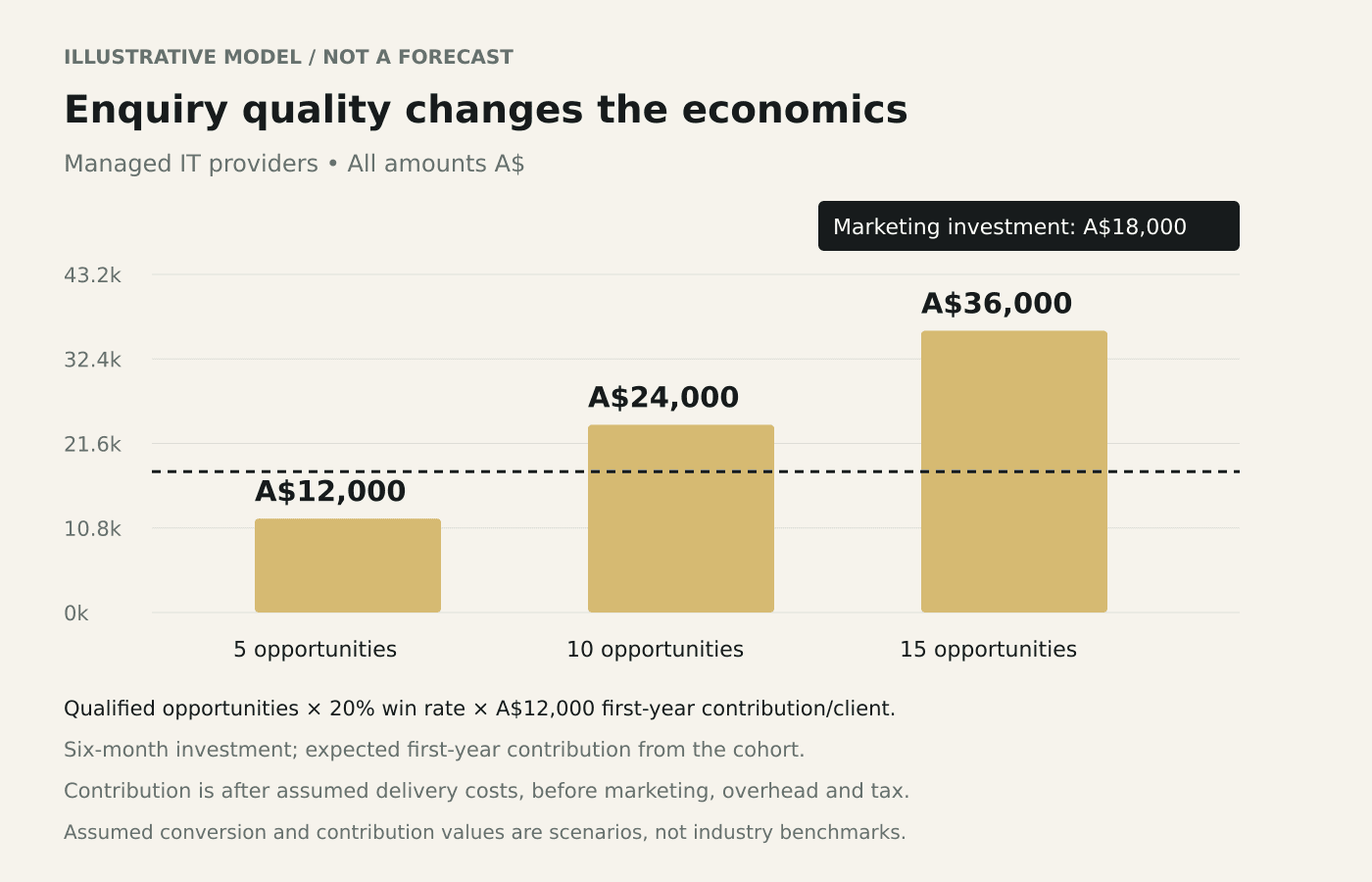
Qualified opportunities × 20% win rate × A$12,000 first-year contribution/client. Six-month investment; expected first-year contribution from the cohort. These are assumptions, not results or benchmarks.
An illustrative model for managed-service enquiries
Suppose an MSP invests A$18,000 in acquisition over six months. Assume a won client produces A$12,000 first-year contribution after direct service and onboarding costs, before central overhead and tax. Assume 20% of qualified opportunities become clients. These are deliberately hypothetical assumptions, not market averages, Creato pricing or promised results.
Expected first-year contribution per qualified opportunity is A$2,400. Five opportunities imply A$12,000 expected contribution; ten imply A$24,000; fifteen imply A$36,000. Against the A$18,000 acquisition investment, those scenarios sit A$6,000 below, A$6,000 above and A$18,000 above the investment before other costs.
This is a cohort model: the acquisition activity occurs during six months, while the contribution belongs to the first year of any resulting client relationship. It is not a claim that all revenue arrives within six months. Probability-weighted outcomes are not guaranteed contracts, and a small pipeline may produce no wins.
Now test the assumptions. If onboarding costs rise, contribution falls. If the sales team qualifies more strictly, the apparent enquiry count may fall while the win rate improves. If a client leaves early, the full first-year assumption is not realised.
Keep retention and expansion as separate scenarios rather than assuming indefinite lifetime value. Use observed cohort data when available. The purpose of the model is to expose the business case and its sensitivities, not to make a marketing proposal look more certain than it is.
Turn the first ninety days into a controlled improvement cycle
First, review the last set of won and lost opportunities. Categorise them by client type, scope, source and reason for outcome. Identify one service-market combination with credible evidence and delivery capacity.
Second, inspect its public journey. Does the service page explain the offer? Can a prospect find relevant evidence? Does the form ask enough to route the enquiry without demanding an entire IT audit? Are responses reaching the right team?
Third, publish the highest-value missing content. A scope comparison, a transition guide and a detailed case study may be more useful than a dozen short trend articles. Have technical staff review accuracy and account managers review whether the language matches real conversations.
Finally, measure the effect. Review qualified discovery calls, proposal progression and reasons for disqualification alongside search performance. Use a small, documented set of AI questions to investigate visibility, recording the platform, date and context. Do not turn a few screenshots into a claim of universal recommendation.
A good monthly discussion should end with a decision: which page to improve, which audience to stop pursuing, or which evidence to gather next. Creato’s guide to useful monthly SEO reporting offers a framework for keeping that conversation practical.
Frequently asked questions
Should an MSP publish per-user pricing?
It can be useful if the inclusions, assumptions and exclusions are clear. A headline seat price without context can attract the wrong comparison. Explain what changes scope, what requires assessment and whether project work or optional services sit outside the recurring arrangement.
Will security content attract only technical readers?
Not if it connects the topic to a real business decision and uses clear language. Explain responsibilities, evidence and next steps rather than relying on acronyms. Keep deeper technical material available where it helps a more experienced buyer evaluate the service.
Can we target every industry with separate pages?
Only publish industry pages where there is genuine relevant experience and a distinct service need. A page that simply swaps an industry name does not establish competence. Do not claim regulatory expertise or compliance outcomes your team cannot substantiate.
Should we publish our full security documentation?
No. Publish enough to explain your assurance approach, then use an appropriate controlled process for sensitive material. Search visibility is not a reason to expose client systems, internal configurations or information that increases operational risk.
What is the most useful conversion to measure?
A qualified discovery opportunity is usually more informative than a raw form submission, but it is still an intermediate step. Follow it through proposal, contract, onboarding and contribution. Define qualification consistently so the numbers remain comparable over time.
Make your expertise easier to evaluate
The strongest MSP marketing does not make technical complexity disappear. It helps buyers understand what matters, what is included and what still needs to be assessed.
Creato can help translate that expertise into a clearer website, focused search content and meaningful enquiry reporting. Explore our SEO services and AEO and GEO approach, or start a conversation about your target clients. The aim is a more credible route to suitable long-term relationships, not another dashboard full of unqualified leads.
For more practical guidance on search, websites and measurement, explore the Creato blog.


