Published
Author

Callum
Categories
AEO & GEO


Ready to take it a step further?
Let's start talking about your project or idea and find out how Creato can help your business grow.
A shutdown planner does not need another supplier promising “end-to-end solutions”. They need to know whether you can support the asset, provide the right people and documentation, and deliver within the constraints of the job. A procurement team then has another set of questions before your company can be engaged.
That is why mining-services marketing cannot borrow a consumer lead-generation playbook unchanged. More website enquiries are not automatically better. A request outside your technical scope, mobilisation capability or commercial appetite can consume substantial estimating time without becoming work.
SEO and AI search can help mining equipment suppliers, maintenance businesses and engineering service providers become discoverable before a shortlist is finalised. But visibility is only the beginning. It does not replace supplier qualification, site requirements, technical approval or a credible delivery plan.
This guide focuses on businesses selling into mining, not mine operators marketing a commodity or consumer businesses near a mine. The approach is national and international, while recognising that procurement systems, safety obligations and operating conditions differ by customer and jurisdiction.
Start with the asset and the operational problem
Describe what you do in terms that a maintenance, reliability or engineering buyer would recognise. Which assets or systems do you support? What type of work do you undertake? Where does your scope stop? Is the engagement planned maintenance, inspection, refurbishment, fabrication, specialist engineering or equipment supply?
Avoid combining unrelated capabilities into one broad “mining solutions” page. A buyer looking for a component supplier needs different evidence from someone evaluating a shutdown contractor. A reliability engineer investigating a recurring failure needs more than a catalogue entry.
Use real enquiry and tender language to shape the content. Ask technical staff which questions help establish fit and which missing facts make an enquiry impossible to assess. The resulting pages should make those distinctions clearer before the buyer contacts you.
For a maintenance provider, a useful page might explain supported asset categories, workshop versus site work, the assessment process and documentation available. For an equipment supplier, compatibility information, support arrangements and specification boundaries may be more important.
Do not publish a capability merely because the team could theoretically attempt it. Market the work for which you have credible experience, appropriate resources and a responsible delivery process. Search visibility should not create commitments the operations team cannot fulfil.
Understand the difference between being found and being qualified
Mining buyers may discover suppliers through industry relationships, technical searches, directories, events or AI-assisted research. They still need to evaluate the business through their own procurement and operational processes.
BHP’s supplier guidance states that adherence to its minimum supplier requirements is a prerequisite for doing business with it. The requirements cover areas including health, safety, environment, community and business conduct. That is a customer-specific example, not a universal checklist for every mine.
Rio Tinto’s supplier guidance likewise describes procurement principles, supplier standards and pre-screening. Together these primary sources illustrate why a search mention cannot be represented as vendor approval.
Your website should help a buyer assess whether it is worth beginning that process. Provide a clear overview of the business, relevant experience, delivery coverage and the route to request qualification material. Keep claims about customer relationships precise and permission-based.
Do not display an operator’s logo in a way that implies endorsement, preferred-supplier status or a current contract unless that statement is both true and authorised. “Worked on a project involving” and “approved supplier to” are not interchangeable claims.
Build separate paths for technical and commercial readers
An engineer may arrive through a detailed asset or failure-mode question. A procurement specialist may arrive through the company name and immediately look for business identity, scope and assurance. A planner may need to establish availability and mobilisation feasibility. Your navigation should make these paths easy.
Create a capability hierarchy that reflects the business. The top level can explain the core offer; supporting pages can address asset classes, service types or applications where there is substantial distinct information. Avoid hundreds of commodity-keyword pages with the same text.
A technical page should explain the work, the evidence of competence and the information required for assessment. A supplier-information page can explain how buyers obtain company details, relevant certifications and other due-diligence material through an appropriate process.
A contact route should distinguish urgent operational enquiries from general tenders and sales discussions, if the business actually provides that distinction. Do not advertise emergency availability or a response window that operations has not approved.
International coverage needs particular care. Distinguish shipping equipment from delivering on-site services. State whether you operate through your own team or a partner, and avoid implying unrestricted mobilisation or regulatory approval across every country mentioned in your content.
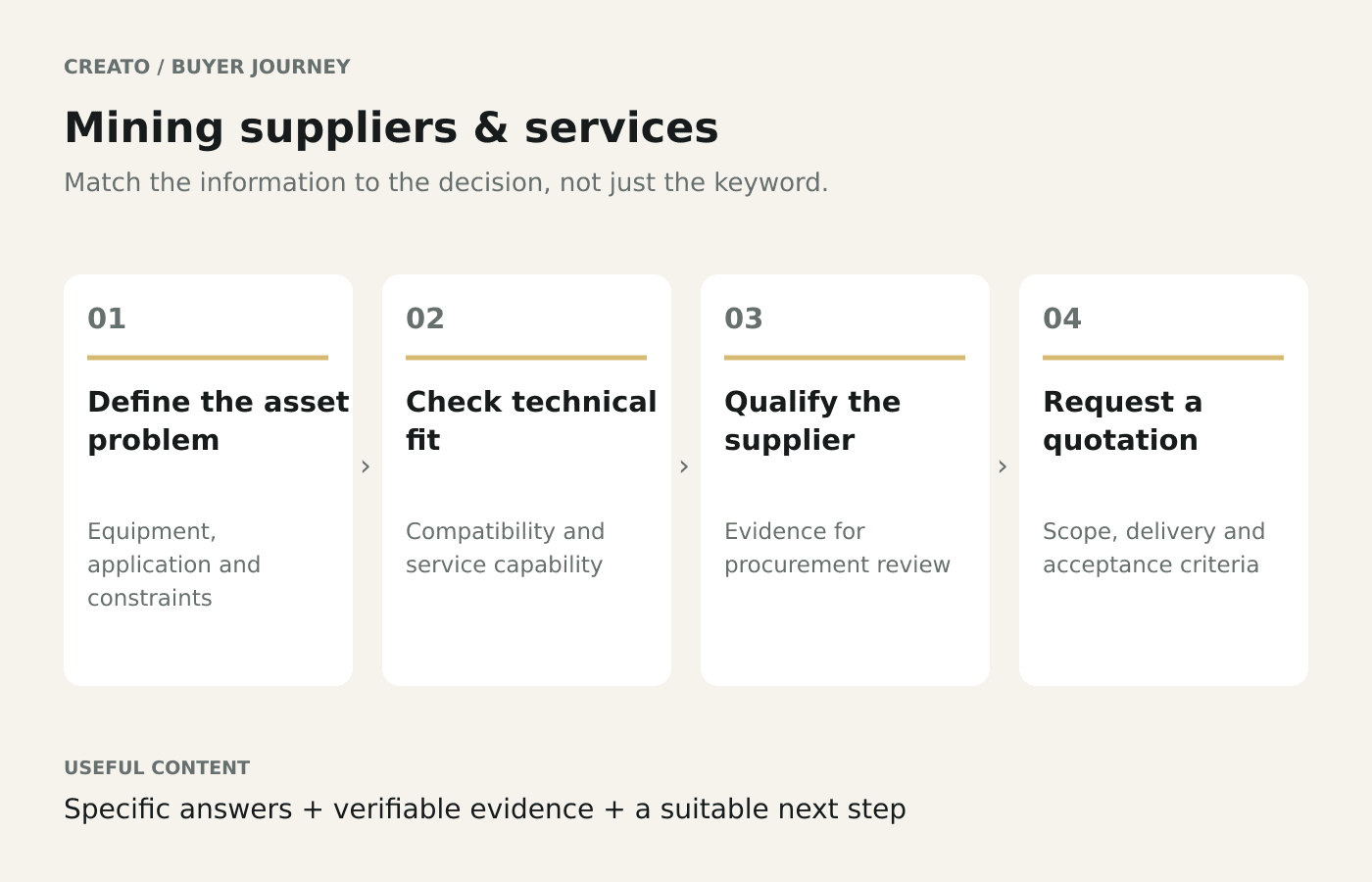
A practical content-planning framework. Real buying journeys may loop or involve several decision-makers.
Make technical content useful without exposing sensitive information
Strong content can explain inspection considerations, maintenance planning inputs, component selection questions or the information required for an engineering assessment. It should help a buyer prepare a better brief, not offer unsafe instructions for operating or repairing a mine asset.
For example, a guide to preparing a refurbishment enquiry can identify the need for asset identification, observed condition, available history and required scope. It can explain that engineering review is needed without publishing a repair procedure or claiming compatibility from a photograph alone.
A technical comparison should identify the conditions under which each option may be relevant and the limits of the article. Have a competent reviewer check the wording. Do not turn a marketing page into an unqualified recommendation for safety-critical equipment or work.
Keep client drawings, site layouts, security information, commercial terms and confidential performance data out of public content unless the necessary permission exists. Use generic original diagrams where they convey the principle without exposing protected information.
This approach does not make the article less valuable. A buyer can learn how to ask the right question while recognising that the final decision requires a properly scoped assessment. That is a stronger trust signal than an overconfident answer to a problem the writer has not inspected.
Show project evidence with boundaries and context
A useful mining-services case study describes the operational context, your precise role, the work delivered and the evidence behind the result. Separate the contribution of your team from the work of the operator, principal contractor and other suppliers.
If you publish downtime, availability, wear-life or cost figures, state the measurement period, baseline and source. Explain important differences in operating conditions. Do not attribute every improvement to your service simply because it occurred after the work.
Where commercial or operational data cannot be disclosed, document the delivery challenge and process at a permitted level. Explain coordination, inspection, quality documentation or handover without inventing a quantified outcome. An anonymised example must still be real if it is presented as a case study.
Use genuine, permission-cleared photographs where possible. Captions should explain what is shown and avoid revealing sensitive site details. An original illustration should be labelled as an illustration, not passed off as evidence of a completed project.
Treat certification, safety and incident claims carefully. Verify the entity, scope, date and context. A statistic without a defined period or denominator can mislead, and a broad claim of “zero risk” has no place in credible industrial marketing.
How AI search fits into the discovery process
AI tools may help buyers explore a technical topic or identify businesses to investigate. Your content should make accurate information available for that stage, while leaving supplier selection to the buyer’s actual evaluation process.
Google’s AI-feature guidance does not promise inclusion for compliant pages. Technical eligibility is a starting point, not a procurement advantage on its own.
For ChatGPT search, OpenAI separates search crawler controls from training controls. Review the intended configuration without exposing protected documents to improve visibility.
Use clear page titles, concise opening explanations and descriptive links between related capabilities. Keep important information in accessible text rather than only in image-based brochures. Maintain the same business identity across the website and credible industry profiles.
Creato’s technical guide to AEO and GEO covers the broader discoverability work. For mining suppliers, the more important editorial question is whether a buyer can verify the claim and understand its limits.
Make the enquiry route match the buying stage
A buyer researching a potential supplier should not have to submit a full tender package to ask an initial question. Equally, a detailed technical request should not disappear into a generic contact form with no routing information.
Offer a staged process. Establish the service or equipment category, project region, timing context and nature of the requirement. Then provide an appropriate route for technical documents or qualification material. Explain what information is helpful and what should not be sent through a public form.
If you accept drawings or asset records, use a suitable secure process and clarify access. Do not imply an automatic confidentiality agreement unless your actual terms establish one. Avoid asking for sensitive site information before it is necessary.
Route enquiries to the right commercial or technical team and test the process with harmless sample data. A technically strong page produces little value if the attached brief is lost or nobody can determine who owns the next step.
Contact Creato if your website needs to serve both early supplier research and more detailed project enquiries. The objective is a clearer route to an appropriate conversation, not simply a shorter form at any cost.
SEO versus ads in a relationship-led market
Paid search can test demand for a precise service, component or problem. Broad mining keywords can also attract job seekers, investors, students and enquiries for equipment you do not supply. Campaign scope and search-term review are particularly important.
Use landing pages that match the actual offer. A specialist refurbishment enquiry should not land on a generic corporate page that forces the buyer to discover the capability again. Do not use advertising to imply an emergency service or stock availability you cannot verify.
SEO supports discovery and validation over a longer period. A technical page may help someone who already knows your name from an industry contact. A clear case study may be circulated internally while procurement assesses whether to progress. Those interactions matter even when they are not the final click before an RFQ.
Neither channel replaces relationships, qualification or tender competence. Compare them using suitable opportunities, estimating effort, progression and awarded contribution, not raw traffic or the number of uploaded documents.
A practical programme can combine a small, tightly scoped paid test with improvements to the capability evidence buyers already inspect. If the business has limited delivery capacity, target the work that fits that capacity rather than pursuing every possible enquiry.
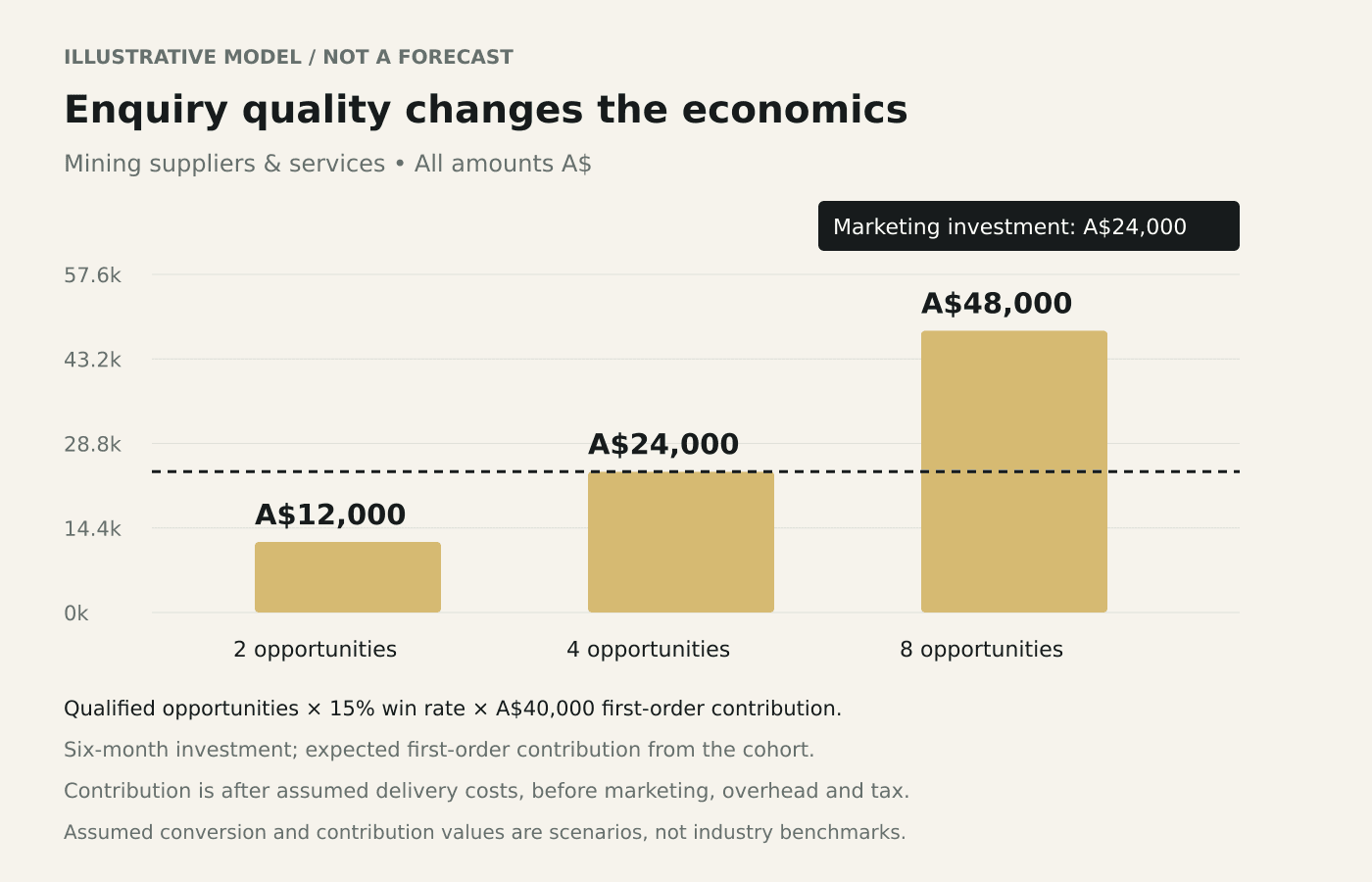
Qualified opportunities × 15% win rate × A$40,000 first-order contribution. Six-month investment; expected first-order contribution from the cohort. These are assumptions, not results or benchmarks.
An illustrative mining-supplier acquisition model
Consider a hypothetical supplier investing A$24,000 in acquisition work over six months. Assume a won first order contributes A$40,000 after direct delivery costs, and 15% of genuinely qualified opportunities become first orders. These are planning assumptions, not industry benchmarks, Creato pricing or expected returns.
Under that model, each qualified opportunity has A$6,000 expected first-order contribution. Two opportunities imply A$12,000; four imply A$24,000; eight imply A$48,000. Relative to the acquisition investment, those outcomes are A$12,000 below, equal to, or A$24,000 above before central overhead and tax.
The model is probability-weighted. It does not mean a fraction of a contract will arrive, and a small pipeline may generate no awards. The first orders may also be won and delivered well after the six-month acquisition period.
Include tender preparation, technical assessment, mobilisation and qualification costs wherever they are not already captured in the contribution figure. Keep potential repeat work separate from contracted work. A framework agreement or vendor registration should not automatically be counted as revenue.
The most useful sensitivity is often qualification quality. If the marketing attracts technically unsuitable requests, increasing volume only increases the burden on estimating. Better capability communication can be valuable even before total enquiry numbers rise.
A practical first ninety days
Start by choosing one capability with clear commercial relevance, available capacity and evidence the business is permitted to publish. Review recent enquiries and tenders to understand where buyers misunderstand the scope or need more information.
Next, rebuild that capability’s public journey. Improve the core page, add a useful technical explainer, clarify the qualification route and publish one credible project or process example. Have technical, commercial and confidentiality reviewers check it before release.
Then connect measurement to the sales process. Record the source, requirement, qualification outcome, estimating effort and progression. Preserve the distinction between early interest, RFQ, tender, approved-vendor status and awarded work.
Use a small documented set of realistic AI questions to investigate discoverability. Record the platform, date, region and cited evidence. Do not interpret a favourable answer as proof that an operator endorses you or that all buyers receive the same recommendation.
At the end of the period, decide what to improve based on actual conversations. A better question bank and fewer unsuitable requests can be meaningful progress while longer procurement decisions remain open.
Frequently asked questions
Can AI search help if most work comes through tenders?
It can support earlier discovery and later validation, but it does not replace tender processes. Make sure your website helps a buyer understand the capability and assess whether further engagement is worthwhile. Measure contribution to the journey without claiming every award came from search.
Should we name major mining clients?
Only when the relationship is accurately described and permission allows it. Do not imply current approval, endorsement or preferred-supplier status from an old project. If naming is not permitted, explain the work at an appropriate anonymised level.
Do we need a page for every mine or commodity?
No. Create pages only where there is distinct relevant capability and useful content. Naming mines you have not served can create a misleading impression. Asset, application and service distinctions may be more useful than a long list of operator names.
What information belongs behind a controlled request?
Potentially sensitive qualification records, client documents and detailed technical material may need controlled handling. Decide based on confidentiality, security and commercial requirements. Public search visibility is not a reason to expose information that the business would normally protect.
How should we define a qualified enquiry?
Use technical fit, geographic delivery feasibility, an identifiable requirement and a credible next step. The exact criteria depend on the business. A message from a major company is not automatically qualified if the requested work falls outside your scope.
Make expertise discoverable, then make it verifiable
Mining suppliers earn trust through competent delivery and credible evidence. Search marketing should make those strengths easier to find, not replace them with broad claims or speculative performance promises.
Creato can help shape capability pages, technical content and enquiry pathways around the way your buyers actually evaluate suppliers. Explore our SEO services, AEO and GEO approach and search strategy resources, or talk to us about your market. The right starting point is the work you can credibly win and deliver.
For more practical guidance on search, websites and measurement, explore the Creato blog.


