Published
Author

Callum
Categories
AEO & GEO


Ready to take it a step further?
Let's start talking about your project or idea and find out how Creato can help your business grow.
A property listing can attract thousands of interested buyers without creating a single new vendor appointment. An agency principal knows the difference between marketing a client’s property and marketing the agency. Website reporting often blurs the two.
That distinction should shape your approach to SEO and AI search. If the business needs listings, the objective is qualified conversations with owners considering a sale. If it needs to grow a rent roll, the objective is suitable landlord enquiries. More visitors browsing available properties may be useful, but it is not the same commercial result.
AI tools can help owners research an agent, understand the selling process or compare property-management options. Your task is to provide credible information for those decisions, then make the next step clear. The goal is not to win every generic property question or claim that a chatbot recommendation proves you are the best agent.
This guide explains a practical strategy for agencies operating in local, national and international markets. Local evidence remains essential, while pricing, agency relationships and property-management rules must be checked for the relevant jurisdiction.
Split vendor, landlord and buyer intent from the beginning
A vendor asks who can sell a property like theirs, how the campaign would be managed and what evidence supports the agent’s advice. A landlord asks how the property will be managed, how communication works and what happens when an issue arises. A buyer searching for a particular home has a different immediate need.
Give these audiences distinct navigation and conversion paths. “Sell”, “Lease or manage my property” and “Find a property” should not all lead to a single generic contact form. The website should help each visitor understand which team will respond and what information is useful.
Build reporting around the same separation. A rental application, inspection registration, appraisal request and landlord management enquiry are not interchangeable conversions. If they are all counted as leads, a campaign can look successful while generating none of the business the agency wanted.
Review the last set of signed listings and new management appointments. Ask which questions arose before the first meeting, what evidence owners requested and why some opportunities did not proceed. Use those conversations to shape content before assuming that broad property-search volume represents commercial opportunity.
Make the agent selection decision easier
Vendors do not simply buy exposure. They evaluate judgement, communication, local knowledge and confidence in the process. Your content should help them assess those qualities without relying on unverifiable superiority claims.
The US National Association of REALTORS’ reporting on what sellers want from agents highlights reputation, honesty and trustworthiness in agent selection. This is US research, not an Australian conversion benchmark or proof of how every owner chooses.
Translate the principle into verifiable evidence. Explain how an appraisal is prepared, how a campaign recommendation is developed and how the seller receives feedback. Show relevant experience with property types and market segments, with permission and accurate dates.
Avoid turning a sales result into a universal promise. A strong result for one property does not establish what another property will achieve. If you publish comparisons, explain the basis and make sure the underlying data supports the statement.
An agent biography should contain more than enthusiasm and a list of suburbs. Describe actual experience, role, relevant qualifications and how the agent works with the team. Keep current listings and past results clearly distinguished so a visitor is not misled about availability or recency.
Build owner-focused pages, not suburb-name variations
A useful local page combines genuine market knowledge with a clear owner decision. It might explain selling a particular property type, preparing a property for an appraisal, or what an overseas landlord should ask about management arrangements in that market.
Do not manufacture hundreds of near-identical pages by changing the suburb name. A page should earn its place through distinct evidence: relevant sales, property characteristics, service coverage, team experience or a useful explanation of the process.
For a multi-office agency, clarify which team serves which area and how enquiries are routed. Consistent names, office details and professional profiles help owners verify that they are contacting the right business. Do not invent offices to make the agency appear more local.
International content needs clear boundaries. A guide for overseas owners can explain your service and the questions to discuss with legal or tax professionals, but it should not present one jurisdiction’s requirements as universal advice. State the market and review date when discussing rules or procedures.
A national marketing strategy should strengthen local evidence rather than dilute it. The owner still needs to know why your agency is suitable for their property and situation.

A practical content-planning framework. Real buying journeys may loop or involve several decision-makers.
Give landlords a separate reason to enquire
Property-management content often receives less attention than sales content, even when recurring management business is a priority. A page that says “we take the stress out of investing” does not explain enough for an owner to compare providers.
Describe the actual service: communication, reporting, maintenance coordination, inspection processes and the way responsibilities are agreed. Explain which services are included and which may incur separate charges, using your verified current terms rather than an invented fee example.
Address common decision points. What information helps an initial management discussion? How is a change of manager assessed and coordinated? How does the team communicate with an owner living elsewhere? What happens when an issue needs the owner’s decision?
Keep legal requirements jurisdiction-specific and professionally reviewed. Do not promise that an agency can eliminate vacancy, prevent every maintenance expense or guarantee a tenant outcome. Practical clarity is more credible than absolute reassurance.
Use a landlord enquiry form that asks about the property region, current management status and intended next step. Do not ask a prospective owner to submit tenant personal information or private documents before there is a clear need and an appropriate handling process.
Explain appraisals without creating false certainty
An owner may ask an AI tool what their property is worth or whether they should sell now. Your agency can contribute useful education without pretending that a general article replaces a considered appraisal or professional valuation.
Explain the information your team reviews, the limitations of online estimates and why the property’s condition and circumstances matter. Make clear what the agency offers and what falls outside that service. Do not use an automated estimate as a guarantee of an eventual sale price.
Consumer Affairs Victoria’s guidance on selling with an agent discusses agent selection and the selling relationship in that jurisdiction. Link readers to the appropriate authority when explaining local requirements, rather than presenting a marketing article as legal advice.
A practical appraisal page can outline the preparation, discussion and next steps. It should also tell the owner whether the enquiry creates any obligation, according to the actual offer. Avoid vague “instant result” language if the form simply adds the person to a call list.
This clarity can reduce hesitation and improve the quality of appointments. It also gives your team a more useful starting point than a phone number with no indication of the owner’s intentions.
What AI search changes, and what it does not
An AI answer may introduce an agency, cite a local guide or help an owner prepare questions. That does not mean the agency has been independently assessed or that every user sees the same recommendation.
Google’s AI-feature guidance keeps normal SEO relevant. There is no guaranteed route from publishing an article to being recommended.
For ChatGPT, OpenAI distinguishes search access from model-training access. Have the website team review the intended configuration rather than treating all AI-related traffic as one category.
Write clear answers to genuine owner questions, support them with evidence and connect them to the appropriate service page. Avoid repeating “best real estate agent” throughout the site or manufacturing lists that name your own agency as the winner.
Creato’s guide to SEO, AEO and GEO explains the broader framework. For an agency, the practical priority is owner intent: what information would help a vendor or landlord decide whether to speak with your team?
Use results responsibly and protect client privacy
A useful sales case study explains the property context, the agreed campaign approach and the result that can be substantiated. Include dates and distinguish the agency’s contribution from market conditions. Do not imply that every similar property will perform the same way.
If publishing time-on-market or price comparisons, define the measure and the comparison group. A selective statistic without context can create a misleading impression. Have the responsible agent verify the records and the wording.
For property management, a process example can be valuable even without a dramatic financial result. Explain how communication or a transition was organised, using permitted details. Do not expose tenant information, private correspondence or sensitive owner circumstances to make a story more compelling.
Photographs and testimonials need the necessary rights and permissions. A photograph used in a listing campaign may not automatically be available for every later promotional purpose. Keep a record of what can be reused and how it must be credited.
Authentic evidence is enough. If the agency does not have a verified statistic for a claim, remove the statistic rather than estimating it. A credible explanation of the work is more useful than an impressive number that cannot survive a question.
SEO versus ads: compare owner opportunities, not listing clicks
Paid search can test a specific vendor or landlord proposition in a defined market. It can also attract buyers, tenants and people looking for an address rather than an agent. Campaign structure, landing pages and conversion definitions determine whether the spend is being evaluated honestly.
A vendor campaign should lead to a page about selling and appraisal, not the general property search. A landlord campaign should explain management services, not ask the visitor to browse rental listings. Keep the language aligned with the actual next step.
SEO builds a longer-lived body of local evidence and owner guidance. It can help validate an agent recommended by a friend, or answer questions during a period when the owner is not ready to book an appointment. That value may not appear in last-click reporting alone.
Compare channels through qualified appointments, signed authorities or management appointments, and eventual contribution. Advertising costs, content production, agent time and follow-up all belong in the assessment. Neither a cheap appraisal request nor a high-traffic article is automatically profitable.
A combined approach can use ads to test a precise offer while improving the organic evidence behind the agency. If your reporting cannot separate owner enquiries from general property activity, ask Creato to review the journey before increasing spend.
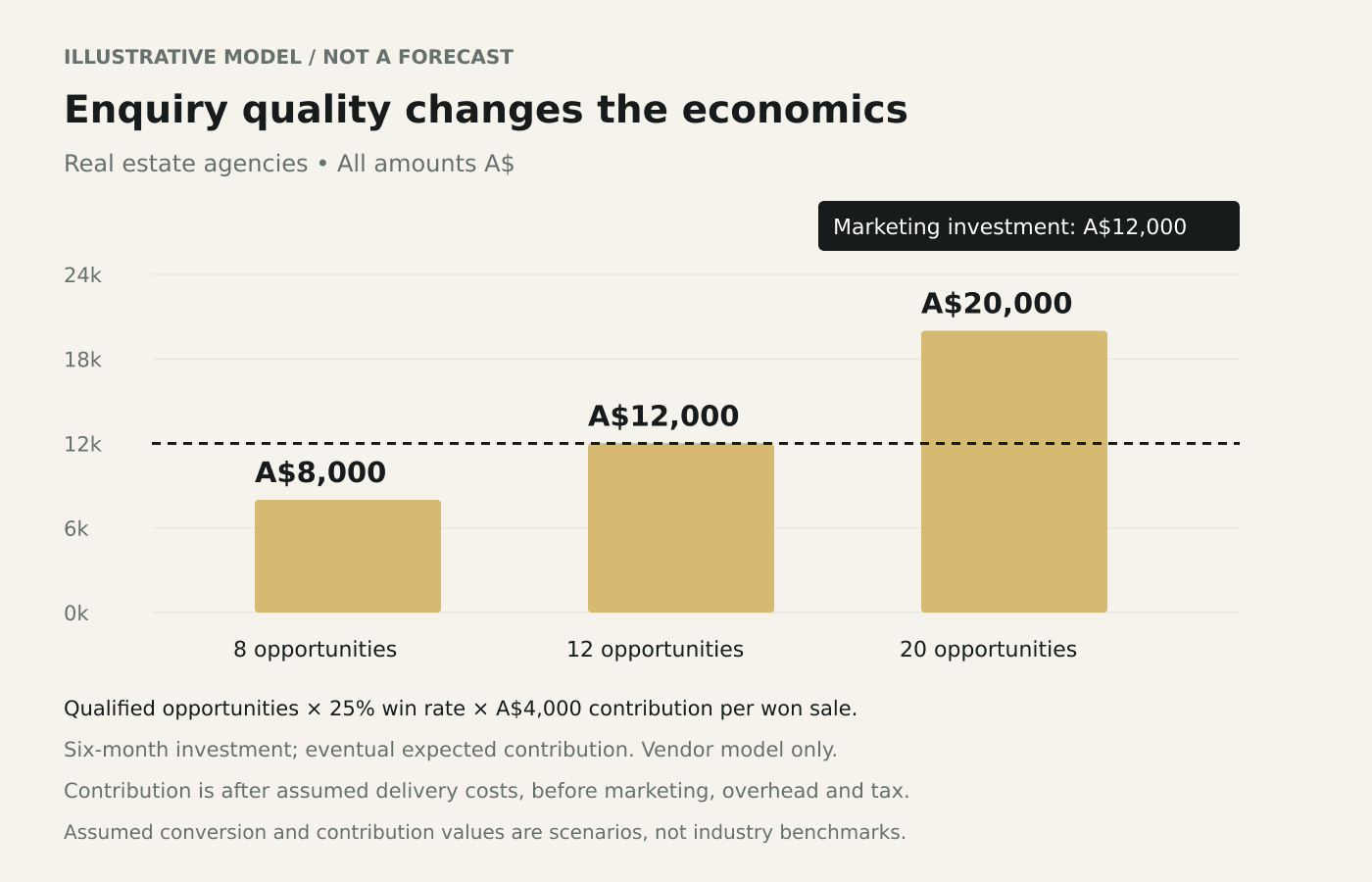
Qualified opportunities × 25% win rate × A$4,000 contribution per won sale. Six-month investment; eventual expected contribution. Vendor model only. These are assumptions, not results or benchmarks.
An illustrative vendor-acquisition model
Consider a hypothetical agency investing A$12,000 over six months in acquisition activity aimed at vendors. Assume each completed sale won through that activity contributes A$4,000 after relevant direct delivery costs, and 25% of qualified vendor opportunities ultimately produce completed sales. These are illustrative inputs, not commission guidance, industry benchmarks or Creato fees.
The expected contribution per qualified opportunity is A$1,000. Eight opportunities imply A$8,000 eventual expected contribution; twelve imply A$12,000; twenty imply A$20,000. Against the A$12,000 investment, those scenarios are A$4,000 below, equal to, or A$8,000 above before central overhead and tax.
This is a cohort comparison, not a six-month cashflow forecast. An owner may enquire during the period and sell later. A signed authority may not lead to a completed sale. A small pipeline can produce very different outcomes from a probability-weighted model.
Replace every assumption with your own data. Make sure contribution accounts for the direct costs and commission splits relevant to the business. Do not substitute gross property value for agency revenue, or gross commission for profit.
Build a separate model for management enquiries using a defined retention period, observed management income and service costs. Do not assume every new property stays forever or combine vendor and landlord opportunities into one average that obscures their different economics.
A ninety-day plan for clearer owner demand
In the first month, separate existing conversions and review recent owner enquiries. Identify which markets and property types the agency wants more of, where it has credible evidence, and which team can handle the resulting conversations.
In the second month, improve the vendor and landlord service pages. Publish one substantial local decision guide and one permission-cleared example that supports each priority. Connect them to the correct enquiry routes and check that the mobile experience is straightforward.
In the third month, review the appointments rather than only traffic. What did owners already understand? Which questions remain unanswered? Which enquiries were unsuitable, and why? Use those findings to refine the pages and any paid campaigns.
Maintain a small record of realistic AI search questions, dates and market context. Note mentions and citations without treating them as universal rankings. The commercial record should show qualified owner conversations, signed business and completed outcomes.
For a useful reporting structure, see Creato’s guide to monthly SEO reports. A good report should help an agency principal decide what to improve, not bury the distinction between buyer activity and new client acquisition.
Frequently asked questions
Should we stop publishing property listings?
No. Listings serve clients and buyers and are central to many agency websites. The point is to measure their role separately from vendor and landlord acquisition. A successful property campaign and a successful agency-growth campaign are related but different outcomes.
Can an agency rank nationally without local offices everywhere?
Educational content can reach a national audience, but service claims must reflect actual coverage. Describe the team and market accurately. Do not imply local representation where it does not exist or create fictitious offices to support location pages.
Is a free appraisal the best call to action?
It depends on the service and the owner’s stage. A discussion about selling plans, a management review or a clearly explained appraisal can all be appropriate. The offer should match what the team actually provides and what the landing page promises.
Should we publish market predictions to attract AI citations?
Only publish analysis that can be supported, with its assumptions and uncertainty clear. Avoid confident price forecasts designed primarily to attract attention. An explanation of current evidence and decision factors can be useful without claiming to know what a market will do.
How do we know whether AI visibility is producing business?
Combine observed referrals, website analytics and an owner’s account of how they found the agency. Track progression to appointments and completed outcomes. Attribution will remain imperfect, so keep direct evidence separate from assumptions and do not assign every branded enquiry to AI.
Build visibility around the owners you want to serve
The strongest agency search strategy is not a contest for the most property-page views. It is a clear, credible route from an owner’s question to an appropriate conversation with your team.
Creato can help structure that route through better service pages, useful local content and reporting that separates activity from commercial results. Explore our SEO services across Australia, AEO and GEO services, or contact us about your agency’s priorities. Start with the vendors and landlords you can serve well, then build the evidence that helps them choose with confidence.
For more practical guidance on search, websites and measurement, explore the Creato blog.


