Published
Author

Callum
Categories
AEO & GEO


Ready to take it a step further?
Let's start talking about your project or idea and find out how Creato can help your business grow.
A prospective client asking for “an architect for a heritage renovation” may not yet have a workable brief, a realistic programme or an understanding of the appointment they need. They may be comparing a feasibility conversation with a full architectural service without realising those are different commitments.
Architects know that the project is shaped before the first polished visual exists. Yet many practice websites begin and end with finished photographs. They show what the practice has designed, but say little about the decisions it helped a client make.
That gap matters in AI search. A buyer asking ChatGPT or Google for a shortlist is often describing a problem, not an architectural style. To be a credible candidate, your website needs to connect relevant project experience with a clear explanation of who you help, how you work and what an initial conversation can establish.
The objective is a better-qualified shortlist and a useful enquiry, not simply a larger audience for your portfolio.
Organise your search strategy around client decisions
Residential clients, developers and organisational clients do not evaluate a practice in the same way. Even within one sector, the early research can vary substantially. A homeowner assessing whether to extend is not asking the same questions as a developer comparing teams for a complex site.
The RIBA guide to working with an architect describes an architect’s contribution to early options, feasibility and briefing as well as later design and delivery. It is a useful reminder that your website can explain value before showing a finished building. The terminology and appointment arrangements should still reflect the market in which you practise.
Map the questions that precede a worthwhile enquiry. What does the client know about the site? Which constraints are already apparent? What kind of project are they considering? Are they looking for early advice, a particular stage of work or a wider appointment? Your content should help them distinguish those needs without pretending to assess their project online.
Residential and private clients
Explain project types in language a client recognises: adapting an existing home, working with a constrained site, restoring historic fabric or designing a new house. Discuss how an initial brief develops and what information is useful at the first conversation. Avoid implying that a particular outcome or approval is assured.
Commercial and development clients
These buyers may be evaluating sector experience, team capacity, procurement familiarity and your ability to work with other consultants. A beautiful image helps, but a clear account of your role, project stage and collaboration can be more relevant to selection.
What “ranking in AI” can and cannot tell you
AI answers are not a permanent league table of practices. A firm can be named for one project type and omitted for another. Answers vary by wording, geography, platform and date, and a mention does not establish professional suitability.
Search engine optimisation helps relevant pages become discoverable. Answer engine optimisation makes your explanations easier to understand as answers. Generative engine optimisation considers how your practice and supporting evidence appear in generated responses. The useful overlap is accurate information about your expertise and clear evidence of relevant work.
Google’s guidance for AI features says conventional SEO best practices still apply. There is no special AI-only requirement that replaces them. Start with the site’s substance and accessibility rather than a promise that a new file or schema label will secure recommendations.
For the wider framework, read Creato’s SEO for AI guide. For practices, the distinctive opportunity is to explain the relationship between expertise, project constraints and client decisions.
Use project pages to show judgment, not just aesthetic preference
A project titled only “House 07” may be meaningful within the studio but tell a prospective client very little. Retain the project name, then add a descriptive subtitle and a concise account of the brief. Explain the building type, broad location and the challenge the project addressed, where publication is permitted.
Describe your actual role. Were you appointed for concept design, a planning submission, detailed design or a broader service? Who else contributed? Is the project completed, under construction, approved or still a proposal? Clear status labels prevent a compelling visual from implying a built result that does not yet exist.
Show the reasoning that connects the brief to the design. An explanation of how an existing structure shaped a layout is useful. A claim that every design choice “maximised value” is not, unless you can substantiate what value means and how it was assessed.
A good project page can include a short brief, constraints, design response, scope of appointment, collaborators, selected visuals and an appropriate next step. It does not need to disclose a private budget, a client’s address or commercially sensitive information.
Where photography or drawings are restricted, use material you have permission to publish. Label visualisations, diagrams and completed photographs accurately. Never use a generated building image as evidence of a commission the practice delivered.

A practical content-planning framework. Real buying journeys may loop or involve several decision-makers.
Create expertise pages that deserve to exist
Choose a small number of genuine specialisms. A heritage-restoration page should explain the kinds of work you undertake, the questions you help clients investigate and the evidence behind that experience. A workplace page should address a different set of decisions, not simply swap the word “heritage” for “commercial”.
Link each expertise page to relevant projects and useful explanations. If the practice works on country houses, an article about briefing for a rural site can connect to completed projects and the relevant service. If you specialise in adaptive reuse, explain how early investigation informs options without offering a remote assessment of a particular property.
Resist the urge to claim every sector. A site that lists schools, hospitals, offices, apartments and luxury houses without supporting work can obscure the practice’s real strengths. Narrow expertise can be commercially valuable when it matches the commissions you want.
Also distinguish professional services from subjects you discuss. Publishing an article about a project type does not mean you should market yourself as a specialist in it. Keep editorial ambition aligned with the practice’s actual experience and capacity.
Make appointment scope understandable
The AIA’s project-preparation questions cover site, goals and working relationships. Use that principle to explain your actual services and appointment process. A website diagram is not the contract.
Address recurring questions directly. What should a prospective client bring to the first conversation? How do you assess fit? When are other consultants involved? What determines the scope of a fee proposal? Explain your process without publishing a universal fee percentage or an unrealistic programme.
Be particularly careful with approval language. A planning submission is not an approval, and experience with a particular authority is not control over its decision. Discuss relevant experience accurately and make project-specific advice part of the appropriate professional engagement.
A well-written process page is also a qualification tool. It can help a client realise that they need early feasibility advice rather than a full design proposal, or that another practice is better suited. Those are useful outcomes even when they do not create an immediate commission.
What Michael Bell’s AI audit demonstrates
Creato’s Michael Bell Architects case study offers a dated example of visibility in a specialist market. The 3 October 2026 audit examined 606 AI answers to NSW architecture buyer questions that did not name a business. Michael Bell Architects appeared in 29.5% of those answers, received 21.5% of architect mentions, and its website received 209 citations.
These results describe a defined question sample, not a global ranking of architects. They also do not prove that an AI mention became a commission. The distinction matters because a practice may see promising visibility long before it can establish the commercial outcome of a project enquiry.
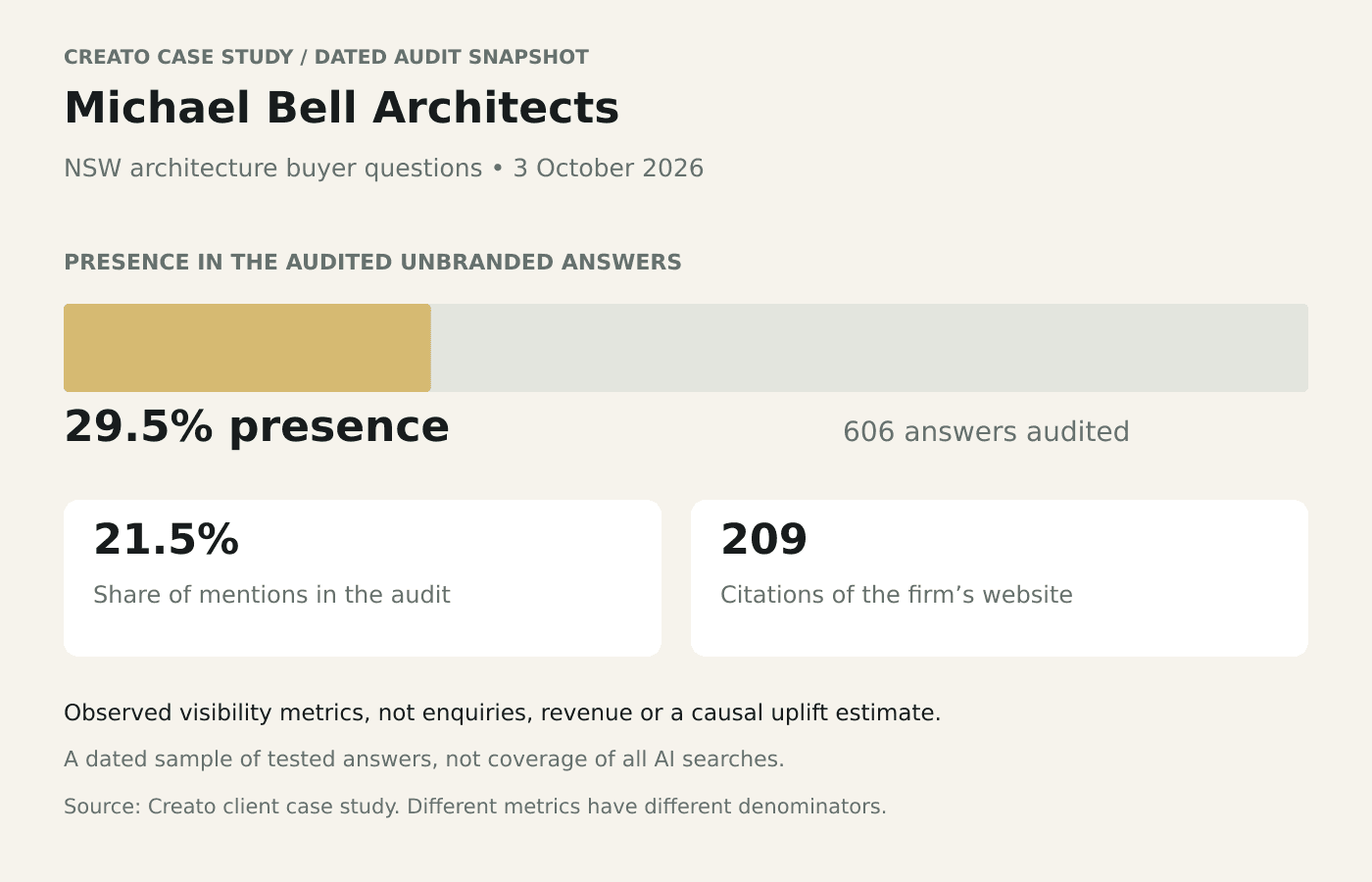
Michael Bell Architects: 3 October 2026 NSW architecture audit, 606 unbranded answers. Visibility measures only, not commissions or a global ranking.
The relevant lesson for an international practice is methodological: define the buyer questions, separate mentions from citations, retain the evidence and evaluate whether the questions match your desired work. Read the dedicated Michael Bell architecture search case study for the results-focused discussion. This guide concentrates on building a useful commissioning journey around that kind of measurement.
Build authority outside the portfolio, without buying empty signals
Professional profiles, published projects, awards and collaborator credits can help people verify a practice’s identity and experience. Keep descriptions consistent and specific. An award should identify the actual project, category and year; a professional designation should be current and accurately stated.
Prioritise relevant recognition over volume. A thoughtful project feature or an accurate association profile can give a buyer useful context. A collection of unrelated directory listings or vague “best architect” badges may add little to a serious selection decision.
Where a publication features your work, check the practice name, project credit and link. Where a collaborator describes the project, ensure your role is not overstated. This is both good professional housekeeping and a way to reduce contradictory information across the web.
Do not treat third-party mentions as something you can guarantee. Earn them through publishable work, useful expertise and legitimate relationships. Avoid fabricated reviews, undisclosed endorsements or invented project outcomes.
National and international content needs geographic honesty
An architecture practice can publish internationally useful guidance without implying it can practise in every jurisdiction. Separate general commissioning education from location-specific services, credentials and regulatory context. State where you operate and how work elsewhere would be assessed.
A guide to preparing an architectural brief can be broadly useful. A statement about consent, registration or technical requirements needs the relevant jurisdiction and qualified review. Do not recycle one country’s process as a universal rule.
For multi-office practices, give each real office useful information: leadership, relevant work, contact details and actual service capability. For a single-office practice, explain travel and project-area considerations honestly rather than manufacturing a national network of location pages.
This also improves the enquiry experience. A client should understand whether they are contacting a locally established team, a practice willing to consider a distant project, or a studio working through an appropriately arranged collaboration.
SEO versus ads for high-consideration commissions
Paid search can put a practice in front of people actively looking for an architect, but the commercial question is whether those people have suitable projects. Broad traffic may include students, job seekers, suppliers and people seeking services outside your scope. Review actual enquiries, not just click volume.
Organic content can support a longer research journey. Expertise pages, project explanations and briefing guides help a client compare practices and return when ready. That does not make SEO automatic or costless. Content, technical maintenance and professional review all require investment.
A balanced approach uses the same evidence-rich landing pages for both channels. Ads may test a defined project type or service area while organic work builds a deeper information base. Do not send an ad about heritage work to a homepage that leaves the visitor to find the only relevant project.
Allocate according to workload and business strategy. A practice seeking one substantial commission has a different acquisition problem from a studio offering a repeatable early-stage service. Marketing should support capacity and project fit rather than produce an indiscriminate queue.
Put a realistic value on a qualified enquiry
Use the practice’s fee income and delivery economics, not the construction value, when assessing acquisition investment. An A$3 million building project is not A$3 million of revenue for the architect. Even the full fee is not available profit.
Consider an illustrative model: a practice invests A$4,000 per month in acquisition, expects a 10% conversion rate from genuinely qualified enquiries to appointments, and estimates A$20,000 contribution per appointment after direct delivery costs over a defined period. The expected contribution per qualified enquiry is A$2,000. Two such enquiries would match that investment in expected contribution, before overhead and other costs.
This is a planning model, not an architectural benchmark, a Creato price or a monthly earnings promise. Appointments are lumpy, projects can pause, and receipts may arrive much later than acquisition costs. A mathematical expected value does not turn two enquiries into a guaranteed commission.
Test a downside case. At a 5% appointment rate and A$10,000 contribution, the same investment requires eight qualified enquiries. If the practice cannot serve additional work without adding significant cost, adjust the contribution assumption again. The model should expose risk, not disguise it.
Measure the pipeline through the stages that matter
Define a qualified enquiry before launching campaigns. Relevant project type, location, broad scope, timing and a plausible next step may be useful criteria. Avoid collecting unnecessary private information just to make a marketing dashboard look detailed.
Track initial enquiries, suitable conversations, proposals and appointments separately. Record why a project does not progress. A mismatch on scope requires a different response from a long decision cycle or a capacity constraint.
For AI visibility, use a stable set of questions around your desired sectors and project problems. Record platform, date, wording, answer and citations. Check accuracy as well as presence. A recommendation based on a service you do not offer should trigger a content review, not celebration.
Combine that with search performance and optional “how did you find us?” responses. Attribution will be imperfect for long-consideration work. Report evidence honestly rather than assigning every later appointment to the last visible click.
A focused starting plan
First, select one type of commission the practice wants more of and can deliver well. Audit the relevant expertise page and two or three projects. Add missing scope, status and process information, and make the enquiry route clear.
Second, publish one substantial explanation of a recurring early client decision. Link it to the relevant projects and service, and have a senior practitioner review it. A useful briefing guide can do more for qualification than several generic trend articles.
Third, establish baseline enquiry quality and a dated AI question sample. Review the data alongside the practice’s actual workload. Expand the content only when you can explain which client decision the next page will help.
Creato’s AEO and GEO services bring content, technical foundations and evidence together. If your portfolio is strong but the enquiry journey is unclear, talk to us about your architecture website and search strategy.
Frequently asked questions
Can AI search replace referrals for architects?
It is better considered another discovery and research route. A referred client may still use search to check your work. Clear online evidence supports that evaluation rather than making professional relationships irrelevant.
Should we publish fees?
Explain the factors that determine scope and how proposals are developed. Whether to publish indicative fees is a practice decision that needs accurate boundaries. Do not publish a universal number that misrepresents what an appointment includes.
How much text should a project page contain?
Enough to explain the brief, your role, the relevant constraints and the design response. The right length depends on the project. Useful specificity is more important than meeting an arbitrary word count on every portfolio entry.
Is a mention in an AI answer proof of success?
It is evidence of visibility in that answer. Success also depends on accuracy, relevant enquiries and eventual appointments. Keep those stages separate so the practice can judge the investment sensibly.
Find more guidance in the Creato blog, including practical approaches to websites, SEO and AI visibility.


