Published
Author

Callum
Categories
AEO & GEO


Ready to take it a step further?
Let's start talking about your project or idea and find out how Creato can help your business grow.
A marketing manager booking headshots for forty people is not buying forty versions of an individual portrait session. They are solving a scheduling problem, a consistency problem and a brand problem. They may need new starters photographed six months later, matching crops for different platforms, and a clear answer about where the images can be used.
A beautiful portfolio proves you can make a photograph. It does not necessarily prove you can manage that assignment. This distinction matters when a prospective client asks an AI search tool which photographer to shortlist, or searches Google for someone who can deliver a specific commercial brief.
The strongest opportunity is not to fill your site with generic “photography tips”. It is to explain the assignments you are genuinely good at, show relevant work, and answer the operational questions that make a buyer comfortable enquiring.
Start with the brief the buyer is trying to solve
“Photographer” is an enormous category. A studio specialising in executive portraits, a product photographer and an architectural photographer may share equipment but sell very different decisions. Your website should make those differences explicit.
For corporate headshots, explain whether you photograph individuals, small teams or larger organisations; whether you work in a studio or on location; and how you handle consistency across sessions. For commercial brand photography, discuss the brief, shot list, locations and intended channels. For product work, distinguish a repeatable catalogue workflow from a styled campaign shoot.
These details create better pages for people and more precise information for search systems. An AI answer comparing photographers for a multi-office team has little reason to rely on a page that says only “capturing moments that matter”.
Make a list of the ten questions buyers ask before approving a quote. Separate questions about creative fit from questions about delivery risk. Build the site around both. A strong portfolio helps with the first; clear process and proof help with the second.
SEO, AEO and GEO are connected, but they are not identical metrics
SEO concerns visibility in conventional search. AEO, or answer engine optimisation, focuses on answering questions clearly. GEO, or generative engine optimisation, considers whether generated answers accurately identify and reference your business.
A photographer might rank well for a city-based search yet rarely be named in broader buyer questions. Another may appear in an AI answer that never sends a measurable visit. Track these separately rather than treating every mention as a booking.
Google’s AI-search guidance confirms that existing SEO fundamentals remain relevant to its AI features. That is a reason to improve the core website, not abandon it for an unproven shortcut. Clear services, relevant evidence and technically accessible pages remain sensible investments.
If you are new to the terminology, our SEO for AI guide explains the broader approach. For a photography business, the useful work starts with making the commercial offer unmistakable.
What the Hero Shot evidence actually shows
Creato’s Hero Shot Photography case study provides a concrete example of measurable AI visibility. In an audit dated 2 October 2026, Hero Shot was named in 65.5% of 715 AI answers to Australian headshot buyer questions that did not name a business. It received 25.7% of photographer mentions across those answers, and its website received 666 citations.
Those figures describe different things. Answer visibility measures how often the business appeared in the sampled answers. Share of mentions measures its proportion of photographer mentions, where an answer can name several businesses. Citations count references to the website. They are not three versions of conversion rate.
The report also compared monthly Google AI visibility in two periods using a DataForSEO index. Average mentions rose from 8.2 in August–December 2025 to 36.1 in March–September 2026; average website citations rose from 2.0 to 22.1. These are observations within the supplied measurement system, not proof that any single website change caused the increase.
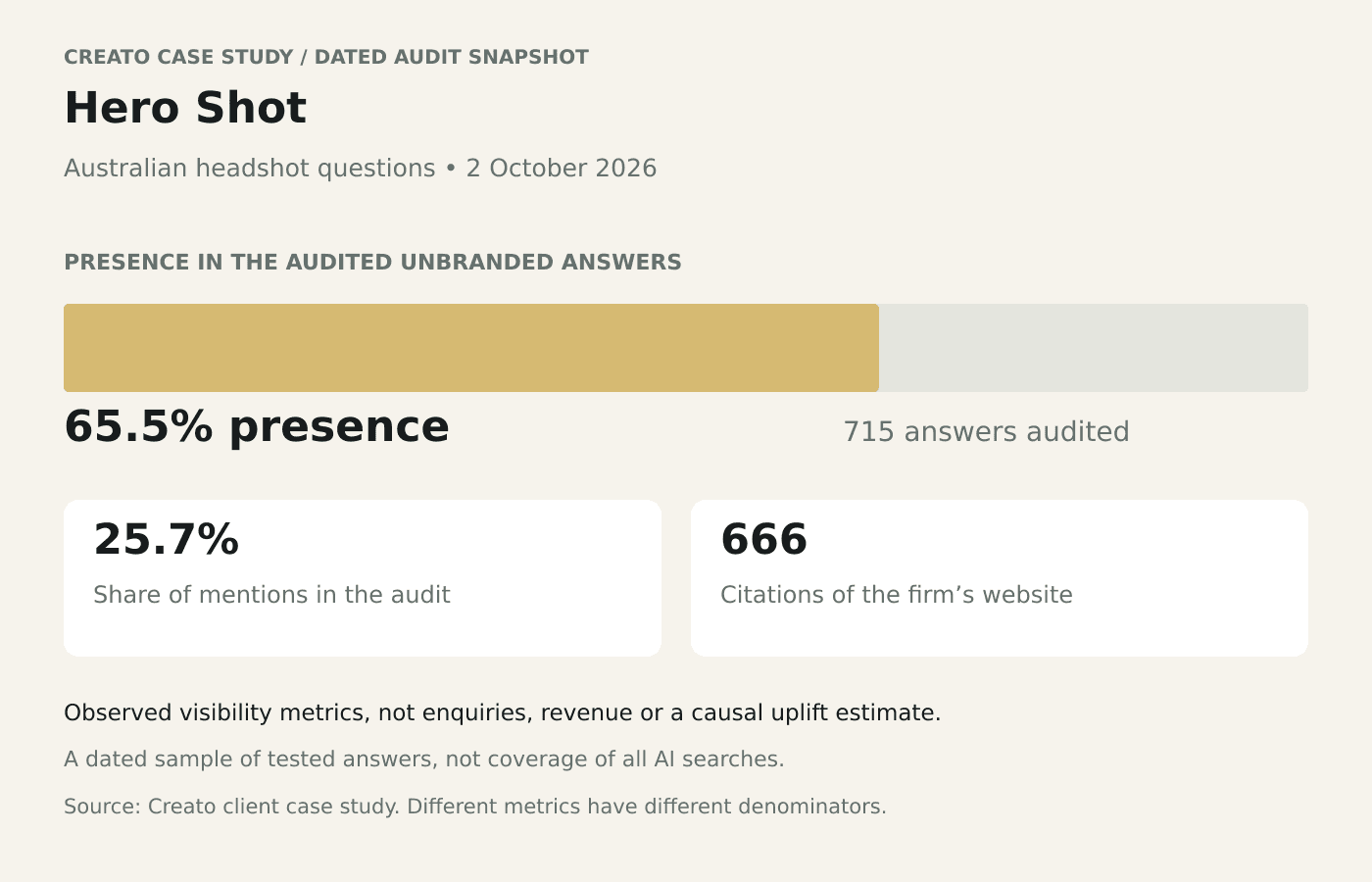
Hero Shot: 2 October 2026 Australian headshot audit, 715 unbranded answers. Visibility measures only, not enquiries, sales or a forecast.
The transferable lesson is to measure both discovery and buyer fit. The result does not establish that every photography niche, country or platform will behave the same way. It does show why “we appeared in ChatGPT once” is too weak a basis for evaluating a search programme. Learn more about Creato’s AEO and GEO approach and case studies.
Build service pages around buying situations, not camera vocabulary
Corporate team headshots
Explain the practical brief: approximate team sizes you can accommodate, preparation, scheduling, selection, retouching and delivery. Describe your real process for employees who miss the main shoot and for maintaining a consistent look later. If those services are not included automatically, make that clear.
Show examples of consistency across different people rather than only your favourite single portrait. A buyer may care less about one extraordinary image than whether thirty colleagues will look like they belong to the same organisation.
Executive and leadership portraits
Discuss the relationship between the person, setting and intended use. Annual reports, media requests and company websites may need different crops or compositions. Describe how you plan a session around those needs without guaranteeing an unlimited set of deliverables.
Commercial brand assignments
Help a buyer understand what goes into an estimate. Location changes, production requirements, talent, image selection, retouching and usage can affect scope. Explain the variables rather than publishing an attractive starting price with no indication of what it covers.
Licensing deserves a plain-language explanation. ASMP’s licensing example illustrates how image use can be specified separately from the act of making the photograph. It is not a current pricing benchmark or a universal contract. Explain your own agreed terms and get appropriate professional advice for the jurisdictions in which you work.
Turn portfolio projects into evidence buyers can evaluate
A useful project page answers “Could this photographer handle something like our brief?” Start with the client’s goal, the practical constraints and what you were engaged to deliver. Then show selected images and explain the decisions that mattered.
For example, a team shoot might describe how a temporary studio fitted into an office schedule and how the visual approach matched an existing brand. A product assignment might explain how consistent angles and backgrounds supported a catalogue. These are meaningful details even when you cannot publish revenue results.
Separate what happened from what you infer. “Delivered a consistent image library for the website and staff profiles” may be verifiable. “Increased the client’s sales by 40%” needs reliable evidence and permission. Do not add business outcomes simply because a case study feels more persuasive with a percentage.
Check permissions before publishing client names, recognisable people, behind-the-scenes images or sensitive locations. Where a project is confidential, explain the process through an accurately labelled general example instead. Never use a stock or generated photograph as if it were commissioned client work.
Your images need useful surrounding information
Photography sites often make text deliberately sparse. That can look elegant, but it can also leave both buyers and search systems guessing about what the images demonstrate. Give each gallery a meaningful title and a short explanation of service, context and purpose.
Google’s image-search documentation recommends standard HTML image elements and informative image landing pages. Its guidance also addresses descriptive alternative text, image quality and performance. This is practical housekeeping, not a promise that an image will appear in a particular result.
Use filenames and captions that help identify the work without stuffing every city and keyword into them. Alternative text should describe relevant visual content for someone who cannot see it. Decorative images may need different treatment from photographs that carry essential information.
Serve appropriately sized images and test on mobile connections. A prospect reviewing your work between meetings should not have to download a print-resolution gallery to understand your style. Preserve enough quality to judge the photography while making the page usable.

A practical content-planning framework. Real buying journeys may loop or involve several decision-makers.
National and international reach without fake local presence
A location-based studio can still publish information useful to international buyers. A company coordinating headshots in several countries may need to understand your local delivery capabilities, brand matching process and communication arrangements.
Be specific about where you physically work, when travel is practical and whether work in another market uses your own team or a separately arranged partner. Do not imply offices, staff or coverage you do not have. A clear operating model is more credible than a footer containing every major city.
Write global topics around genuinely shared decisions: commissioning a team shoot, preparing a commercial photography brief, or keeping a headshot library consistent. Keep location-specific service pages for actual delivery areas. That separation helps avoid multiple pages competing for the same search intent.
Where markets use different terminology, explain it naturally. “Corporate portraits” and “business headshots” may overlap, but their context matters. Do not multiply almost identical pages simply to capture every wording variation.
When ads make sense, and when organic work is the better first step
Search ads can help reach buyers with a current brief and test a clearly defined offer. They are most useful when the landing page, enquiry process and response capacity already work. Sending paid traffic to an undifferentiated portfolio can produce expensive browsing without a usable brief.
Organic search content can answer earlier research questions and support comparison over time. It is not free: writing, photography selection, technical work and maintenance have costs. Nor is it instant. The case for investment depends on the quality and economics of the enquiries it helps generate.
Use the channels together where appropriate. An ad may bring someone to a team-headshot page, while a project case study or preparation guide helps them decide. Review paid search terms for mismatches such as jobs, equipment, free images or unrelated portrait styles, and avoid assuming that a high click-through rate means commercial fit.
Allocate around capacity. A studio with empty weekday production time may value a different campaign from a photographer already booked months ahead who wants fewer, larger assignments. Search strategy should reflect the work you want and can deliver.
Model enquiry value using contribution, not the biggest invoice
Suppose a studio considers A$2,400 per month for a combined search programme. Assume, purely for illustration, that one in four qualified enquiries becomes a booking and that the average booking contributes A$1,200 after direct production costs. The expected contribution per qualified enquiry is A$300. Eight qualified enquiries would therefore match the A$2,400 investment before overhead and other costs.
Change the booking rate to one in eight and the required enquiries double to sixteen. Keep the one-in-four rate but reduce contribution to A$600 and the same doubling occurs. These are assumed inputs, not photography-industry averages or a Creato price.
Do not count the entire invoice as available return. Assistants, studio hire, travel, editing and production can materially change the contribution from a job. Repeat bookings may improve the economics, but only include them when your own records support the assumption.
For ads, separate media cost from management and landing-page costs. For organic work, compare a defined investment period with outcomes over an appropriate period rather than pretending every article pays back in its first month. Use the same qualification standard across both channels.
A simple measurement system for a working studio
Record the source where known, requested service, estimated project value, qualification status, quote and booking outcome. Add a reason for unsuitable enquiries: wrong location, wrong service, unavailable date or insufficient scope. A small, consistently maintained spreadsheet can be more useful than an elaborate dashboard nobody updates.
Keep AI monitoring separate. Use a repeatable set of buyer questions, including comparisons and practical constraints, and save the date, platform and answer. Track accurate mentions and useful citations. Do not count a recommendation for a service you do not offer as a win.
Ask enquirers how they found you, but allow uncertainty. A client may first see an AI answer, later search your name and finally contact you from a saved bookmark. Report what is observed rather than claiming perfect attribution.
What to work on first
Choose the service you most want to sell profitably. Build or improve its page, add two genuinely relevant projects, answer the questions that delay quotes and test the form. Link to that page from related content and from the appropriate portfolio entries.
Then fix technical issues that stop the work being discovered or used. Check important pages are accessible, confirm images load correctly, and make contact details easy to find. Only after those foundations are sound should you expand into a larger library of articles.
If you want an outside view, ask Creato to review your photography website and search journey. The useful starting question is not “How many blog posts do we need?” It is “What stops a suitable buyer from understanding and trusting our offer?”
Frequently asked questions
Will AI-generated headshots make SEO for photographers pointless?
No single content strategy can settle how that market develops. Focus on the assignments where your real service has a clear value proposition: coordinated teams, direction, location work, brand consistency and an accountable production process. Explain that value with evidence rather than attacking alternatives.
Should every gallery have a long article?
No. Match the depth to the project and decision. A concise, informative project explanation can be better than padding a gallery with generic advice. Substantive service guides belong where they answer recurring buyer questions.
Can I guarantee a ChatGPT recommendation?
No. Platforms and answers vary. You can improve clarity, discoverability and evidence, and measure a defined sample. You cannot promise a permanent recommendation or position.
What is the best first content topic?
Choose a question that regularly prevents a good prospect from enquiring or approving a quote. A useful explanation of team logistics, scope or delivery is often more commercially relevant than another general posing guide.
Explore more practical website and search guidance in the Creato blog, or talk to us about a focused SEO, AEO and GEO plan for the photography work you want to win.


