Published
Author

Callum
Categories
AEO & GEO


Ready to take it a step further?
Let's start talking about your project or idea and find out how Creato can help your business grow.
A vacant room is not the same thing as available support. A provider can have an attractive property and still be the wrong fit for a participant’s support needs, preferred location or living arrangements. SIL and SDA are different services, yet websites sometimes place both under a vague “accommodation” heading and leave the reader to untangle them.
That is a search problem as well as a communication problem. When someone asks an AI tool to help compare providers, the useful answer depends on details: what support is offered, where it is delivered, who it suits, and what the next conversation involves. A homepage promising “quality care across Australia” does not answer those questions.
For NDIS providers, effective SEO and AI search visibility start with making genuine service fit easier to understand. The goal is not to win every enquiry. It is to help suitable participants, families and referrers find accurate information and make an informed next step.
What does ranking an NDIS business in AI actually mean?
There is no single AI results page with a permanent position one. A provider may be named in an answer, have a webpage cited, appear in conventional search results, or be absent. The answer can change with the question, location, platform and date.
SEO makes relevant website pages easier to find through search. Answer engine optimisation, or AEO, focuses on clearly answering the questions people ask. Generative engine optimisation, or GEO, considers how a business and its evidence are represented in generated answers. These are overlapping activities, not three disconnected websites to build.
Google’s guidance on AI features says established SEO practices remain relevant and there is no special additional optimisation requirement for AI Overviews or AI Mode. Be wary of a pitch built around secret AI tags or guaranteed recommendations. A provider needs accurate pages, discoverable evidence and useful content before it needs another acronym.
Our guide to SEO for AI explains that broader foundation. The NDIS-specific challenge is ensuring that visibility does not outrun the accuracy of the service information.
Build for three different research journeys
The participant choosing support
A participant may want to know whether workers can support a particular routine, whether the service respects their preferences, and whether an introductory conversation is possible. Use plain language, describe choices and explain what happens after an enquiry. A warm photograph cannot substitute for a clear process.
Give practical answers without making assumptions about an individual’s disability or needs. Explain how people can tell you their communication preferences, request accessible information or ask someone to support them during an initial conversation. Avoid presenting a diagnosis as a complete description of a person.
The family member researching options
Family members may be comparing continuity, communication, locations and the provider’s approach to changing needs. Answer those questions without making the family the automatic decision-maker. Write to participants directly and explain how the provider includes chosen supporters where appropriate.
The coordinator or professional checking fit
A referrer needs a faster route to operational information. Service coverage, intake criteria, current availability, relevant experience and a working referral contact matter more than a long brand story. An easily maintained referral page can save repeated calls while preventing stale information from spreading.
Do not combine these journeys into an enormous form. Let a person ask an initial question before requesting detailed information. A short, respectful enquiry can establish whether a more secure intake process is appropriate.
Give each real service a page with a clear job
Begin with the services you actually deliver, not every high-volume phrase an SEO tool suggests. A useful structure might separate community participation, daily living support and supported independent living, with additional distinctions where they are operationally meaningful. The NDIA’s home and living support categories are a useful terminology reference, not a template to copy into claims about your own offering.
Each page should answer a compact set of questions near the top:
What does this service involve in your organisation?
Which areas can your team genuinely cover?
What can a prospective participant ask about before proceeding?
How is current capacity confirmed?
What information is needed for the first conversation?
What does the provider not offer through this service?
Then add detail: an example of the process, relevant team experience, useful practical considerations and a clearly labelled contact route. Distinguish a general explanation of support from a promise that a person will receive funding or be accepted.
Location pages should reflect real delivery differences. A regional team with a particular travel boundary and intake contact deserves its own explanation. Fifty pages that change only the suburb name do not give families fifty useful resources. National visibility should mean a coherent national information strategy, not pretending every provider operates everywhere.
Registration, availability and service claims need an owner
Outdated operational details are especially damaging in this sector. Assign a person to review service areas, contact details, capacity statements and registration descriptions. Add a review date to information that changes, and replace “available now” when that is no longer true.
Check registration descriptions against the NDIS Commission’s provider register. Do not treat an application as approval or describe registration more broadly than the verified status supports. Requirements and transitional arrangements can change, so avoid publishing a sweeping rule about who may deliver every support type. Have the responsible compliance person check the wording.
This is not about filling a page with badges. It is about helping someone reconcile your website with independently checkable information. A business name, trading name, service description and contact details should tell the same story wherever a person encounters them.
Likewise, separate “enquiries welcome” from “immediate capacity”. If availability depends on rostering or an individual assessment, say that. Honest qualification is more useful than attracting enquiries your intake team already knows it cannot progress.
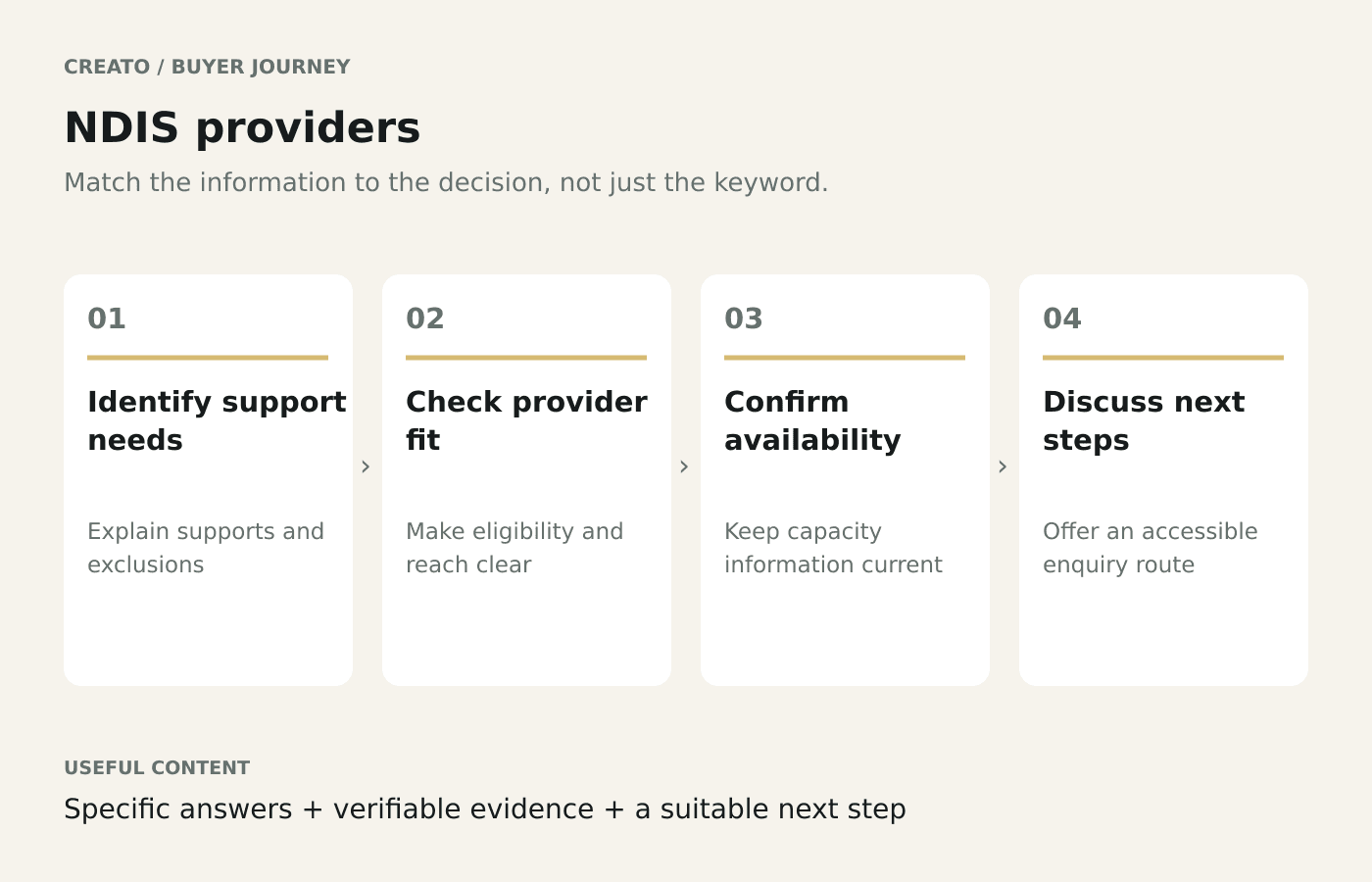
A practical content-planning framework. Real buying journeys may loop or involve several decision-makers.
Write answers that help, rather than manufacture authority
Useful article topics come from real intake conversations. Consider “What should I ask before choosing a community participation provider?”, “What happens in our first support-planning conversation?” or “How do we keep participants informed when a regular worker changes?” Keep the answer tied to your actual process.
A strong answer begins directly, then adds the necessary qualifications. For example: “We confirm current availability during your initial enquiry because it depends on the support requested and the area.” Follow that with the practical next step. Do not bury the answer under several paragraphs about your commitment to excellence.
Use staff expertise carefully. Identify who reviewed a service explanation and their relevant role. Publish the review date. If a topic concerns funding, eligibility or regulated requirements, link to the appropriate official guidance and keep the provider’s explanation within its expertise. Marketing content should not become personalised advice.
Participant stories require particular care. Use only material with appropriate permission, keep the person’s agency central, and do not publish sensitive details simply to create a convincing case study. An anonymised operational example can explain a process, but it must be clearly labelled and must not masquerade as a real testimonial.
Creato can help turn that service knowledge into a clear content structure through our AEO and GEO services, without turning every page into an aggressive sales pitch.
Make the website easy to use before chasing more visitors
Review the website on a small screen and without assuming the visitor will use a mouse. Check text size, contrast, heading order, meaningful button labels and whether forms explain errors clearly. Test with people who use the service where possible. Accessibility is an ongoing design and testing task, not a badge that proves every visitor will have a good experience.
Keep important service information in readable page text. Avoid making a brochure PDF the only source of coverage, capacity or contact information. Offer downloads as an additional format rather than forcing everyone through them.
Make photographs descriptive and respectful. Use authentic images with the necessary permissions. Captions should explain a setting or activity rather than imply that everyone pictured is a participant or that a stock photograph shows your staff. Alternative text should describe the relevant visual information, not repeat marketing keywords.
Finally, test the entire enquiry journey. Does a submission reach the right inbox? Does the visitor see a confirmation? Can someone phone or choose another contact method? More visibility amplifies broken intake as readily as it amplifies a good service.
SEO versus paid ads: start with capacity, not channel fashion
Paid search can support a defined service and area when there is capacity to handle enquiries. It provides a way to test whether a message attracts suitable interest, but clicks alone do not show that the campaign is useful. Review search terms, unsuitable enquiries and progression to an appropriate intake conversation.
SEO builds a library of service explanations and decision resources that can continue to be discovered. It requires maintenance, and results are uncertain. AI visibility adds another observation layer; it should not replace measuring whether people can find the right information and contact you successfully.
The combination can be sensible. A paid campaign might point to a well-built service page while organic content answers earlier questions. Use advertising language and targeting appropriate to a sensitive service category and have campaigns checked against current platform requirements. Do not imply knowledge of an individual’s health circumstances.
Pause or narrow promotion when the advertised team has no practical capacity. A marketing calendar that ignores the roster risks wasting money and disappointing people. A smaller number of well-matched enquiries can be more valuable than a dashboard full of form submissions.
A responsible investment model for provider marketing
Do not use a participant’s full plan budget as the “value” of a lead. It is not your revenue, much less your profit. For internal planning, estimate the contribution from services you can actually deliver over a defined period after the direct cost of delivery. Keep the participant’s suitability and choice separate from the financial calculation.
Here is a deliberately hypothetical example, not an NDIS benchmark or a Creato result. Assume an A$3,000 monthly acquisition investment, a 20% rate from suitable enquiries to service commencements, and A$1,500 contribution per commencement over the chosen measurement period. Ten suitable enquiries produce an expected two commencements and A$3,000 contribution, before overhead and other costs.
At a 10% progression rate, the same investment needs twenty suitable enquiries to reach that contribution figure. At 25%, it needs eight. That sensitivity is the point: a marketing plan should state its assumptions rather than promise that traffic will pay for itself.
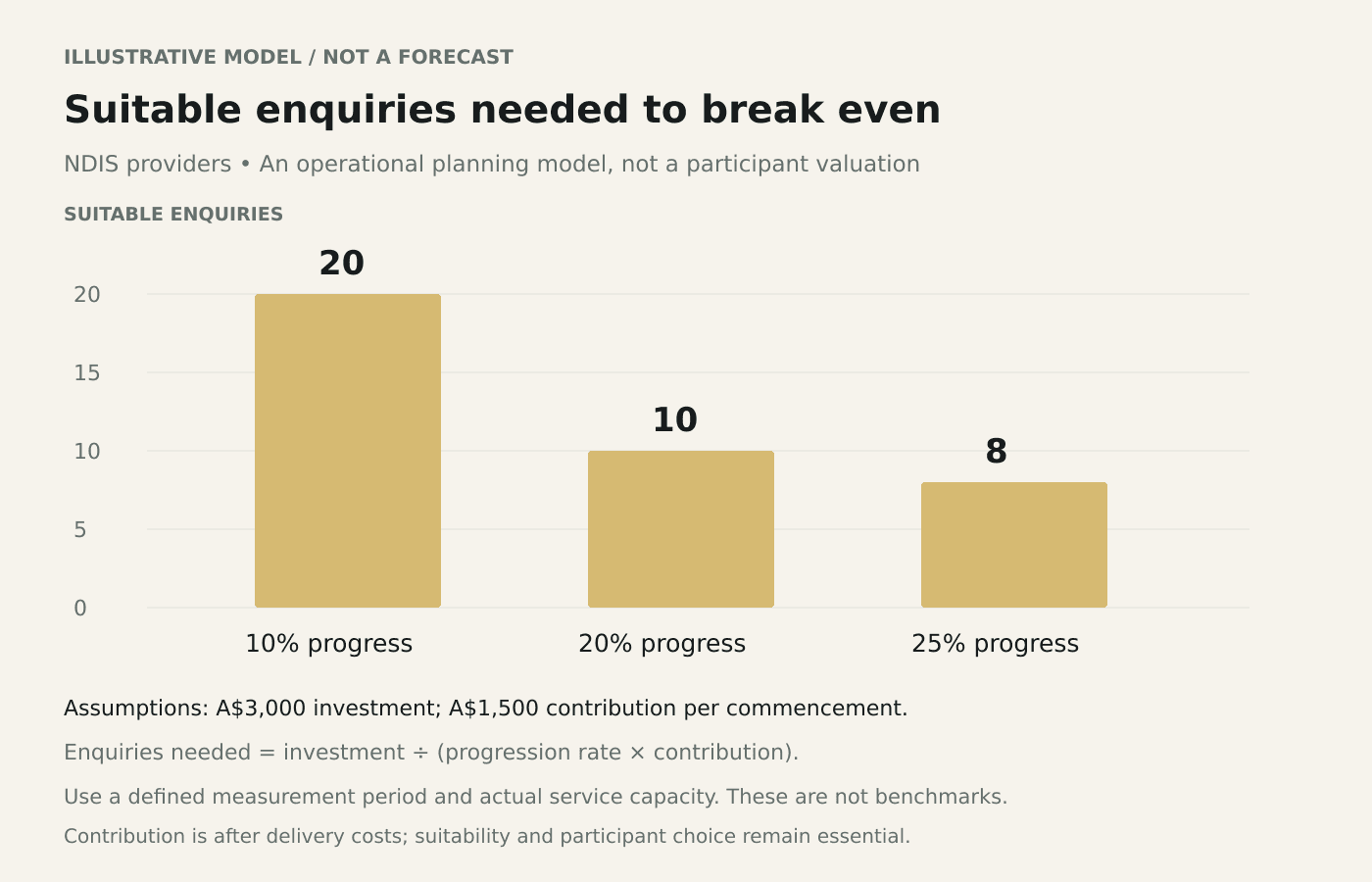
Illustrative assumptions only: A$3,000 ÷ (progression rate × A$1,500 contribution per commencement). Not a forecast or participant valuation.
Track actual outcomes with appropriate privacy controls. Separate spam, out-of-area requests, unavailable services, suitable enquiries and commencements. Avoid putting personal support details into advertising analytics. Aggregate reporting can show whether the system is working without exposing an individual’s circumstances.
Measure AI visibility without confusing it with referrals
Build a small question set around your real services and coverage. Include practical comparison questions, process questions and location-specific questions. Keep branded questions separate from questions that do not name a provider. Otherwise, asking an AI about your own business can make visibility look much stronger than it is.
Record the platform, date, wording, answer and cited page. Measure whether the provider is named, whether the description is accurate and whether a useful page is linked. Repeat a consistent sample over time, while acknowledging that generated answers vary. An isolated screenshot is evidence of one answer, not permanent market leadership.
Then compare that observation with qualified website enquiries and referral conversations. Ask people how they found you in an optional, simple field. A person may discover you through an AI answer, return through Google and enquire directly. Attribution will be incomplete; do not force every enquiry into a certainty the evidence cannot support.
A practical first-month sequence
Start by checking your five most important service pages against operational reality. Correct contradictory service areas, registration wording and capacity statements. Test forms and alternative contact routes. These changes reduce harm and wasted enquiries before any new content campaign starts.
Next, map the questions your intake team answers repeatedly. Choose three that genuinely help people decide, and produce substantive answers reviewed by the appropriate staff member. Add links from the relevant service pages, not just from the blog index.
Finally, establish a simple baseline of organic enquiries, suitable-enquiry rate and a dated AI question sample. Review these alongside capacity and response times. Improve the weakest point in the journey rather than commissioning dozens of articles without a working intake system.
Frequently asked questions
Can an NDIS provider pay to be recommended in ChatGPT?
Do not confuse an advertising product with an independent generated recommendation. This article concerns improving discoverability and the evidence available about your business. No agency can promise that a particular provider will be recommended for every relevant question.
Should we publish articles about every disability?
Only where the topic genuinely matches your services and expertise, and where you can publish a useful, appropriately reviewed explanation. A diagnosis-keyword library is not a substitute for clear service information and can attract enquiries you are not equipped to help.
Can we use participant outcomes as proof?
Only with appropriate permissions and careful, accurate presentation. Do not imply that another participant will have the same experience. Where permission or evidence is missing, explain your process instead of manufacturing a testimonial.
What should we improve first?
Start with the accuracy and usability of the pages closest to an enquiry. A provider with unclear coverage or a broken referral form does not need more visitors first. It needs a clearer route from interest to an appropriate conversation.
If you want help identifying those gaps, talk to Creato about your provider website and search visibility. We can help prioritise useful service content, technical improvements and measurement. For more practical guidance, explore the Creato blog.


